If you've ever tried to help someone with dementia get dressed in the morning and ended up in a standoff that left you both exhausted before the day even started, you already know that the hardest moments in dementia caregiving aren't always the dramatic ones. They're the daily ones. The bath that turns into a struggle. The shirt that becomes a source of real distress. The refusal that comes out of nowhere and doesn't respond to any reasoning you try.
These moments are common. They're also one of the most undertreated topics in dementia care — covered in broad strokes in most caregiver guides but rarely addressed with the kind of specific, practical detail that actually helps in the moment.
This article is an attempt to do that. It won't solve every difficult moment, but it will give you a clearer picture of why resistance happens and what approaches tend to work better than the ones most of us instinctively reach for.
Why resistance happens — and why it isn't stubbornness
The first thing worth understanding is that resistance to bathing, dressing, and personal care is not willful. It is not stubbornness, manipulation, or a personality trait that can be reasoned away. It is a predictable, neurologically grounded response to what dementia does to a person's brain — and understanding that changes how you approach it.
Several things are typically happening when someone with dementia resists personal care.
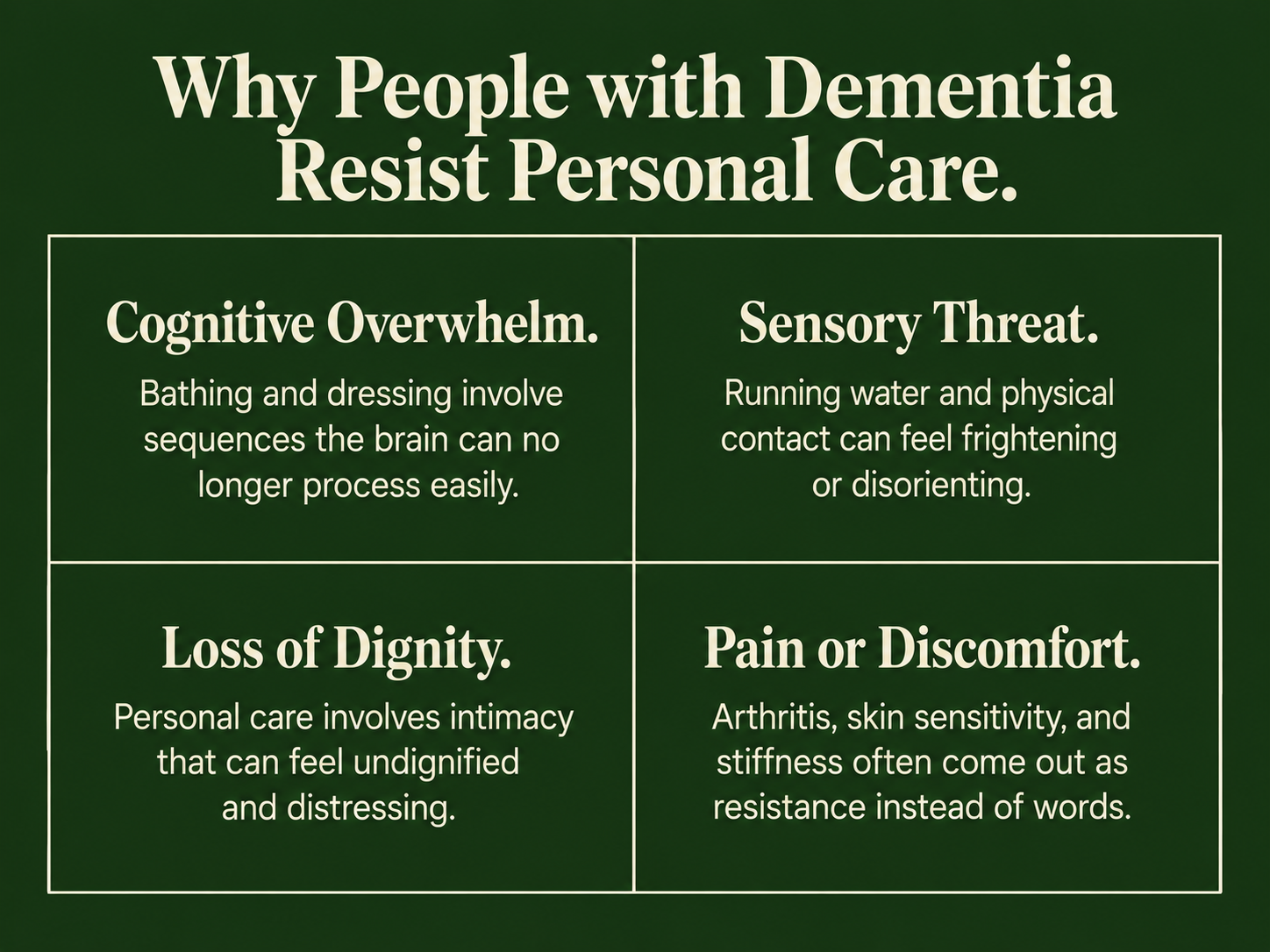
The task itself is overwhelming
Bathing and dressing involve a sequence of steps — undress, adjust water temperature, step into the shower, wash hair, rinse, dry, dress — that most of us execute automatically without conscious thought. For someone with dementia, the ability to process and sequence multiple steps is significantly impaired. What feels to you like a simple morning routine can feel to them like being asked to solve a complex problem they no longer have the cognitive tools to manage. The resistance is often an attempt to escape an overwhelming experience, not a refusal of the outcome.
The environment feels threatening
Running water, the sound of a shower, the sensation of having clothes removed — these sensory experiences can feel threatening or disorienting to someone with dementia who can no longer accurately interpret what's happening to them. A person who is frightened by something they can't make sense of will resist it. That fear is real, even if what's triggering it seems ordinary to everyone else in the room.
Loss of privacy and dignity
Personal care involves a level of physical intimacy that most adults have not shared with another person since childhood. For someone who retains awareness of what's happening — which many people with dementia do, even in more advanced stages — being undressed and bathed by another person can feel profoundly undignified. Resistance is sometimes a communication of that discomfort in the only way still available.
Pain or physical discomfort
Arthritis, skin sensitivity, joint stiffness, and other physical conditions are common in older adults with dementia. Water temperature that feels comfortable to you may feel too hot or too cold to them. A sleeve being pulled over a stiff shoulder may be genuinely painful. People with dementia often cannot accurately report pain — it comes out as resistance instead.
The wrong moment
Dementia affects energy levels and cognitive function unevenly throughout the day. Attempting personal care when someone is tired, hungry, or in a period of cognitive low — something particularly common in late afternoon and evening — is more likely to produce resistance than attempting the same task at a time when the person is rested and relatively clear.
What doesn't work — and why we keep trying it anyway
Most of the approaches caregivers instinctively reach for when resistance occurs are the wrong tools for the situation. Understanding why helps break the pattern.
Reasoning and explaining
"You need a bath because you haven't had one in three days." "The doctor said it's important to keep your skin clean." These statements are logical. They are also almost entirely ineffective for someone with moderate to advanced dementia, whose brain can no longer reliably process logical argument and apply it to behavior. Reasoning requires working memory and executive function — both of which dementia attacks directly. Explaining why something needs to happen rarely changes whether someone with dementia is willing to do it.
Insisting
Pushing through resistance — physically or verbally — typically escalates it. When a frightened or overwhelmed person encounters force, the fear and resistance increase. What starts as a refusal can become genuine distress, aggression, or a lasting association between personal care and threat that makes future attempts even harder. Insisting rarely works and frequently makes the next attempt more difficult.
Arguing or correcting
"Yes you do need a bath." "No, you had a shower yesterday, not this morning." Arguing with someone about their perception or memory is one of the least productive things a caregiver can do, and in the context of personal care it adds an emotional layer of conflict to an already difficult task. It doesn't change the person's experience — it just adds frustration to it.
Approaches that tend to work better
None of these are guaranteed. Dementia is variable, and what works beautifully one day may not work the next. But these approaches are grounded in how dementia actually affects the brain, and they work better more often than the alternatives.
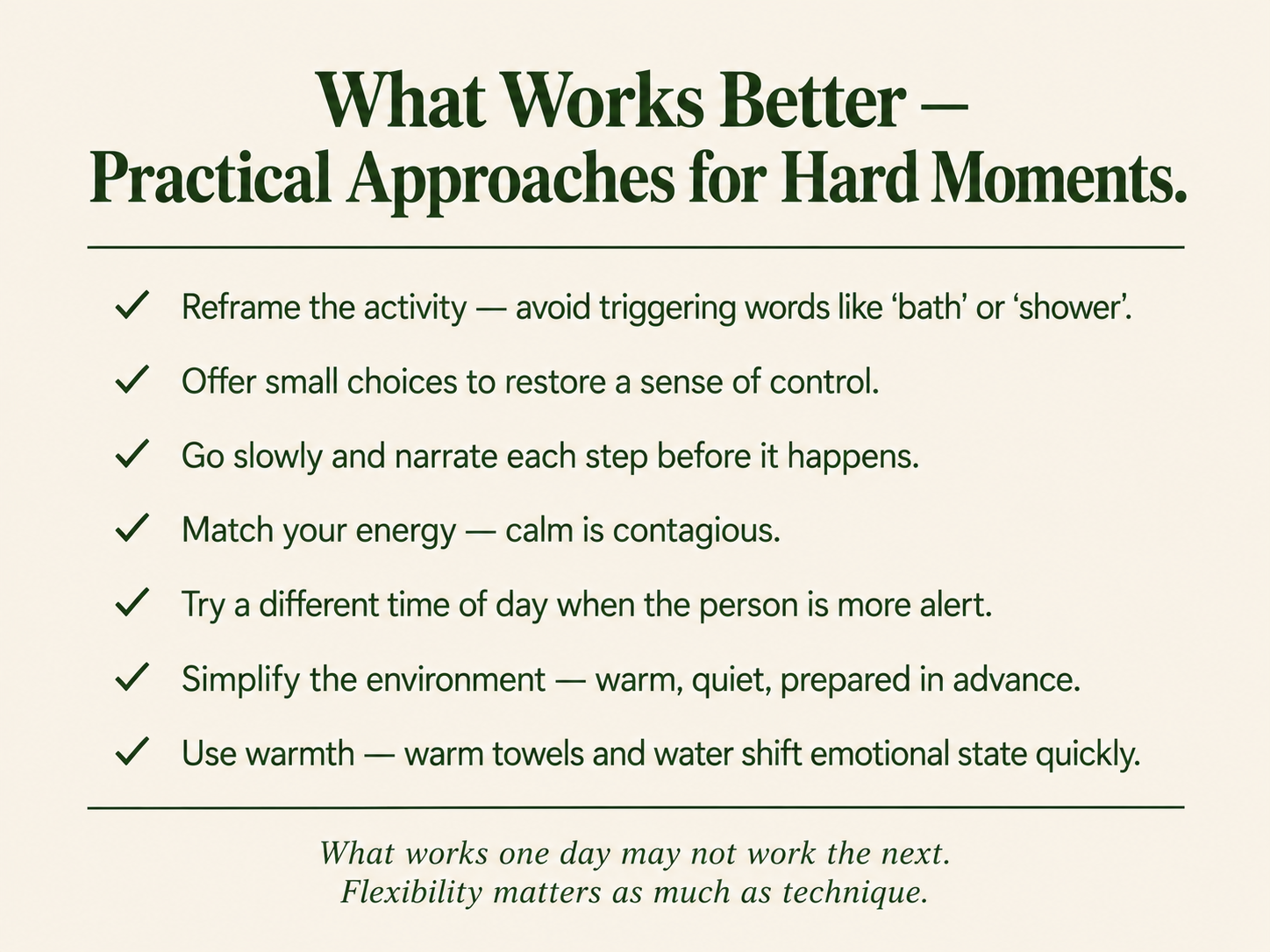
Reframe the activity
Instead of "it's time for your bath," try "let's get you freshened up" or "I've got some warm water ready for you." The word "bath" or "shower" can trigger an immediate negative response in someone who has come to associate it with an unpleasant experience. A different framing — one that doesn't announce the destination — sometimes bypasses that association entirely.
Offer choice and control
"Would you like to start with your hair or your face?" "Do you want the blue towel or the white one?" Choice is a way of restoring a sense of control to someone who has lost much of it. The choices themselves are small and the outcome is the same either way, but the act of choosing changes the dynamic from something being done to the person to something the person is participating in. This is one of the most consistently effective tools in dementia caregiving.
Go slowly and narrate
Moving slowly and describing each step before it happens — "I'm going to help you take off your sweater now" — gives the person time to process what's coming rather than experiencing it as something happening to them without warning. Sudden movements and unannounced physical contact are common triggers for resistance and distress. Slowing down and narrating is one of the simplest and most effective adjustments caregivers can make.
Match your energy to the outcome you want
Anxiety and urgency are contagious. If you approach a bath or dressing task feeling rushed, tense, or braced for a fight, the person with dementia will pick up on that emotional tone even when they can no longer follow the words. Approaching the task calmly — even when you don't feel calm — changes the emotional environment in ways that matter. This is easier said than done, but it is genuinely important.
Try a different time of day
If morning bathing is consistently difficult, try late morning or after lunch when the person tends to be more rested and alert. Most bathing schedules are set by caregiver convenience rather than the person's optimal time of day. Adjusting the schedule to match the person's cognitive rhythms rather than forcing the person to adapt to the schedule is a simple change that can make a significant difference.
Simplify the environment
Reduce noise, dim harsh lighting, close the bathroom door to retain warmth, lay out clothing in the order it will be put on. A quieter, warmer, less stimulating environment reduces the sensory overwhelm that contributes to resistance. Have everything prepared before bringing the person into the space so the process can move smoothly rather than involving delays that increase anxiety.
Use warmth — literal and figurative
Warm towels from a towel warmer or dryer, a warm bathroom, a warm washcloth applied to the face first — these sensory cues communicate safety and comfort before the task begins. The physical sensation of warmth is one of the most effective tools for shifting someone's emotional state in a positive direction, and it works even when language doesn't.
Try a different approach to the task itself
If full showers are consistently causing significant distress, a bed bath or a basin bath can achieve the same hygienic outcome with far less disruption. No-rinse shampoo, dry shampoo, and rinse-free body wash products can reduce the frequency of full bathing required. Hair washing — often the most distressing part of bathing — can be done separately from body washing. The goal is cleanliness and comfort, not adherence to a specific method of achieving it.
Meet them where they are
If someone believes it's 1965 and they're getting ready for work, the conversation that helps them get dressed may have nothing to do with the actual morning and everything to do with that reality. This is sometimes called therapeutic fibbing or compassionate redirection — entering the person's reality rather than correcting it. "Let's get you dressed and looking sharp for the office" may be more effective than any amount of orientation to the actual date and situation. For many caregivers this feels dishonest at first. With practice, it comes to feel like kindness.
When resistance becomes a safety concern
There is a difference between resistance that is manageable — difficult, emotionally draining, but workable with the approaches above — and resistance that poses a genuine safety risk. If someone is consistently becoming physically aggressive during personal care, if you are at risk of being hurt, or if the person with dementia is injuring themselves in the course of resistance, this is a signal that the current care arrangement needs professional support.
A trained dementia caregiver, an occupational therapist with dementia experience, or a geriatric care manager can conduct an assessment and help develop a specific approach tailored to the person's stage of disease and behavioral patterns. This is not a failure of caregiving — it is the appropriate next step when a situation has exceeded what untrained caregiving can safely manage.
A note on what this actually asks of caregivers
The approaches described in this article require something that is genuinely difficult to sustain without support: patience, emotional regulation, and the willingness to set aside instinctive responses in favor of ones that work. That is a real and significant demand. Family caregivers who are managing this alone, without relief, are less likely to be able to sustain these approaches over time — not because they don't care enough, but because sustained emotional regulation requires rest that unsupported caregivers often can't get.
If you are a family caregiver navigating these moments on your own, getting professional support isn't giving up. It is what makes it possible to keep going.
How professional dementia caregivers approach these moments
Caregivers trained specifically in dementia care — particularly those trained in frameworks like Teepa Snow's Positive Approach to Care — approach resistance to personal care differently from untrained caregivers. They understand the neurological basis of resistance, they've practiced the specific communication and redirection techniques that work for this population, and they've developed the emotional regulation skills to stay calm in difficult moments through experience rather than willpower alone.
They also bring something equally important: they are not the person's family member. The emotional complexity of a child bathing a parent, or a spouse managing a partner who no longer recognizes them, adds a layer of difficulty that professional caregivers don't carry in the same way. Sometimes the same task that triggers significant resistance with a family member goes smoothly with a professional caregiver — not because the professional is more skilled in every dimension, but because the relationship is different.
If you're in the Triangle area and navigating this
Guiding Light Dementia Care specializes exclusively in dementia care in Raleigh, Durham, Chapel Hill, Cary, Wake Forest, and surrounding Triangle communities. Our caregivers are trained in Teepa Snow's Positive Approach to Care, which addresses the specific communication and behavioral challenges of personal care resistance directly. Our RN Director of Care Services provides clinical oversight for every client, including behavioral assessment and care plan adjustments when difficult patterns emerge.
If you're struggling with these moments and want to talk through what support might look like, we're glad to have that conversation. Reach us at (984) 205-2870 or GuidingLightCare.com.
Guiding Light Dementia Care provides specialized in-home dementia care in Raleigh, Durham, Chapel Hill, Cary, Wake Forest, and surrounding communities in the Triangle area of North Carolina.
Continue Reading