For many people, driving is not just transportation. It is independence, identity, and the ability to move through the world on their own terms. Giving it up is one of the most significant losses a person faces as they age, and when dementia is part of the picture, the conversation about driving becomes one of the hardest a family will have.
It is also one of the most necessary.
Dementia affects the cognitive and physical abilities that safe driving requires: reaction time, attention, spatial judgment, the ability to process multiple pieces of information simultaneously, and the capacity to respond quickly and appropriately when something unexpected happens. As the disease progresses, driving becomes not just risky for the person with dementia but for everyone else on the road.
This article is written for families navigating this conversation. It covers when driving becomes unsafe, how to recognize the warning signs, how to have the conversation in a way that is honest and compassionate, and what to do when the person refuses to stop.
Why this conversation is so hard
Understanding why this conversation is difficult helps families approach it with more patience and less frustration.
For the person with dementia, driving represents something far larger than the act of operating a vehicle. It represents autonomy, competence, and full participation in adult life. When someone suggests they should stop driving, they are often hearing something much harder than a practical suggestion about transportation. They are hearing that they are losing control of their life.
People with dementia frequently lack insight into the extent of their own impairment. This is not denial in the way most people understand it. It is a neurological feature of the disease. The same brain changes that impair judgment and self-awareness also impair the ability to accurately assess one's own capabilities. A person with dementia may genuinely believe they are driving safely when objective evidence says otherwise, and arguing with that belief using logic and evidence is rarely effective.
Add to this the fact that families have their own complicated feelings about this conversation: guilt about taking something away, fear of conflict, uncertainty about whether they have the right to intervene, and sometimes grief at yet another marker of how much has changed. These feelings are understandable and deserve acknowledgment. They also cannot be allowed to delay a conversation that has real safety consequences.
When driving becomes unsafe with dementia
There is no universal bright line at which driving with dementia becomes unsafe. The disease affects different people differently, and some individuals in early stages may continue to drive safely for a period with appropriate monitoring. What is clear is that driving ability typically declines as dementia progresses, and at some point, continued driving is no longer safe for anyone.
A formal driving evaluation by a certified driver rehabilitation specialist is the most objective way to assess current driving safety. These evaluations, offered at many hospital rehabilitation centers and occupational therapy programs, assess both cognitive and physical driving-related abilities and result in a professional recommendation. For families who want an objective basis for the conversation, this is often the most useful step.
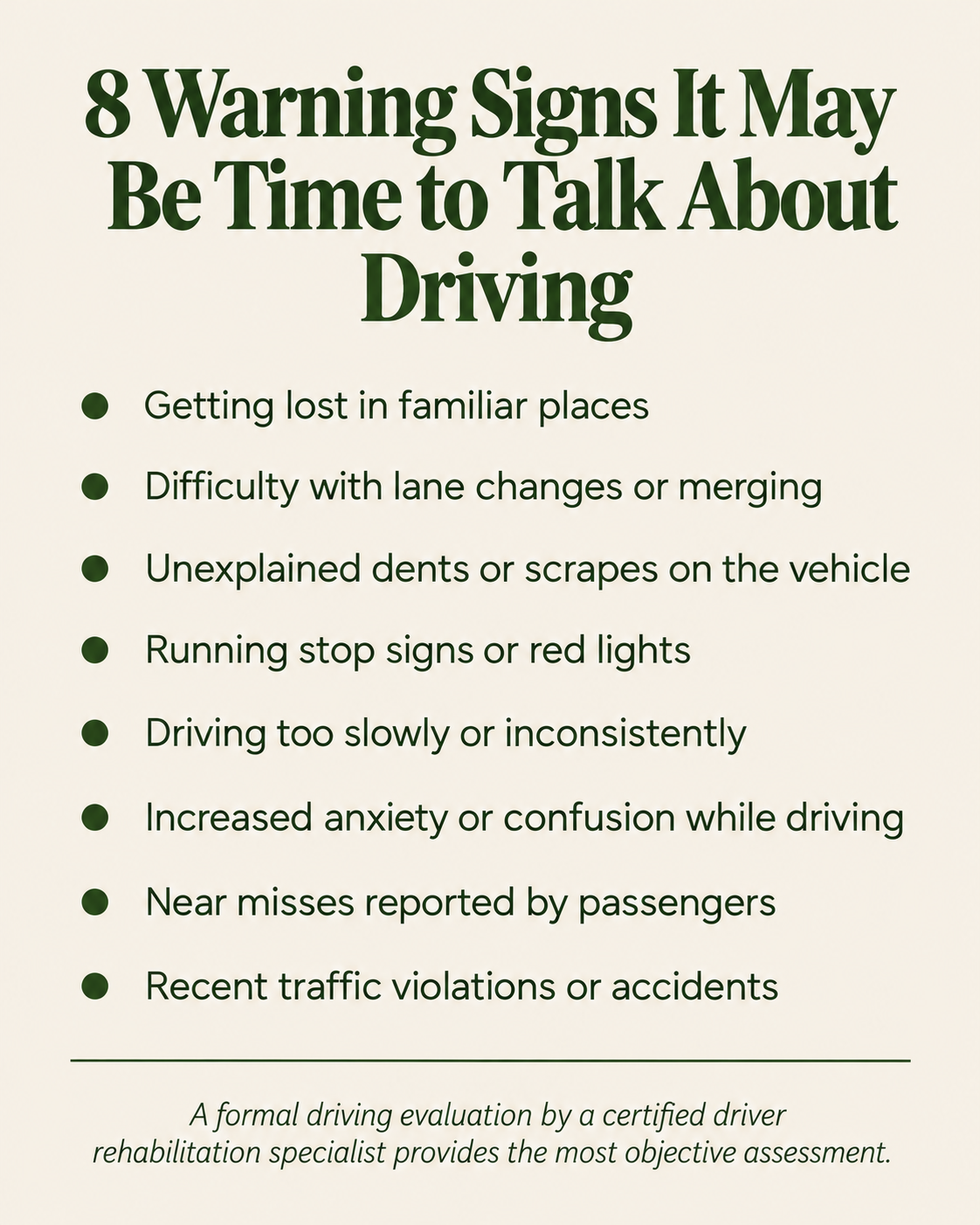
Short of a formal evaluation, families should watch for the following warning signs.
Getting lost in familiar places
Becoming disoriented in a neighborhood or on a route the person has driven for years is a significant warning sign. Familiarity is one of the last competencies to erode in driving, and losing it suggests meaningful impairment.
Difficulty with lane changes and merging
Safely changing lanes or merging onto a highway requires rapid processing of multiple moving objects. Difficulty with this is an early indicator of the processing speed and spatial judgment problems that make driving dangerous.
Unexplained dents, scrapes, or damage to the vehicle
Physical evidence of minor collisions that the person may not have fully registered or reported is a concrete and observable warning sign.
Running stop signs or red lights
Difficulty recognizing and responding to traffic controls is a direct safety risk and should be treated as such.
Driving too slowly or inconsistently
Significant slowing below traffic speed, difficulty maintaining lane position, or erratic speed changes suggest the person is struggling to manage the demands of driving.
Increased anxiety or confusion while driving
If the person has begun to express anxiety about driving, avoid certain roads or times of day, or seem confused during drives, these are signs they may be aware on some level that something is wrong.
Near misses reported by passengers
If passengers have experienced frightening moments in the car without the driver seeming to register that anything unusual happened, this is a serious warning sign.
Recent traffic violations or accidents
Any at-fault accident or traffic citation warrants a serious reassessment of driving safety.
Having the conversation
There is no version of this conversation that is easy. But there are approaches that tend to go better than others.
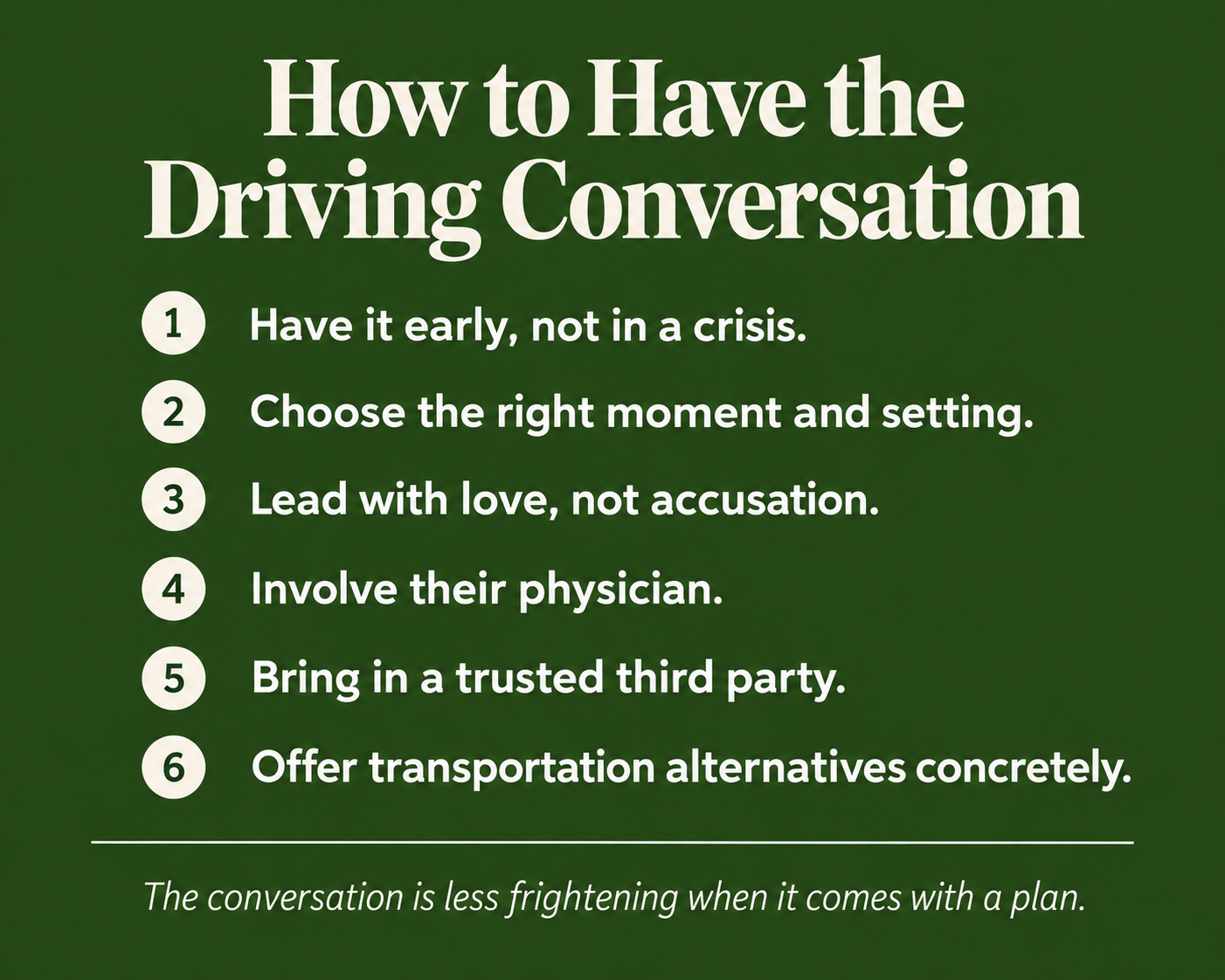
Have it early, not in a crisis
The best time to begin talking about driving is before it becomes an emergency. A conversation about future planning, "I want us to think about this together while we still have time to figure it out," lands differently than a conversation forced by an accident or a close call. If you are reading this article before a crisis has happened, you have an opportunity most families do not take advantage of.
Choose the right moment and setting
Do not have this conversation when either of you is tired, stressed, or pressed for time. Choose a calm moment, a private setting, and a time when the person is relatively clear and alert. Do not raise it in front of others.
Lead with love, not accusation
The framing matters. "I am worried about your safety" lands differently than "You are not safe to drive." Centering your concern on your love for the person rather than their deficit gives the conversation a different emotional starting point. "I could not forgive myself if something happened to you" is a genuine expression of care that most people can hear even when they disagree with the conclusion.
Involve their physician
For many people, a recommendation from their doctor carries more weight than the same information from a family member. Ask the treating physician to raise driving with the patient directly, or to refer them for a formal driving evaluation. If the physician is reluctant to have this conversation proactively, ask them to address it at the next appointment and let them know you will raise it yourself if they do not.
Bring in a third party
When the conversation is deadlocked between family members, a trusted third party can sometimes break through. This might be another family member the person respects, a long-time friend, a clergy member, or a geriatric care manager who has experience navigating these conversations. Sometimes being told the same thing by a different voice changes how it lands.
Offer alternatives concretely
The conversation is less frightening when it comes with a plan. "We want to figure this out together so you can still get where you need to go" is more reassuring than simply taking something away. Research ride options, identify family members who can help with transportation, look into local senior transportation services, and have these alternatives ready to present as part of the conversation rather than as an afterthought.
When the person refuses to stop driving
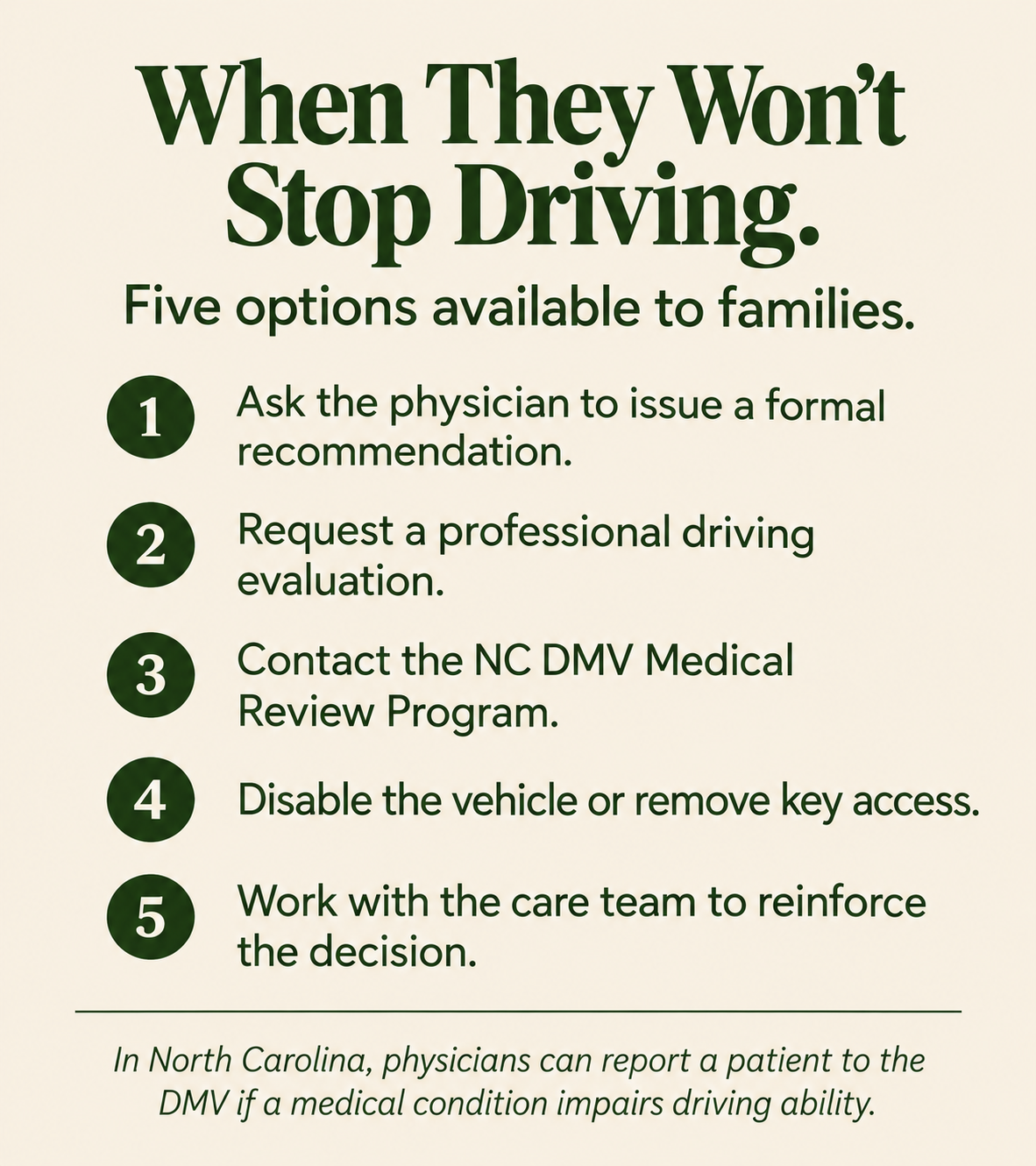
Refusal is common, and it requires families to think carefully about next steps. The following options are available, and in some cases a combination of them is necessary.
Contact the physician and request a formal recommendation
In North Carolina, physicians can report a patient to the Division of Motor Vehicles if they believe the patient has a medical condition that impairs their driving ability. A formal recommendation from the physician to stop driving, delivered directly to the patient and documented in the medical record, often carries more weight than family members alone can generate. Ask the physician explicitly whether a DMV report or a formal driving evaluation referral is appropriate.
Request a driving evaluation
A formal evaluation by a certified driver rehabilitation specialist provides an objective third-party assessment. If the evaluation concludes that the person is not safe to drive, that finding is harder to dismiss than a family member's concern. Some people are more willing to accept the conclusion from a professional they do not have a family relationship with.
Contact the DMV directly
In North Carolina, concerned family members can contact the DMV to report a potentially unsafe driver. The DMV can require the person to undergo a medical review and driving test. This route can be emotionally difficult because it can feel like an act of betrayal, and it may generate real anger. It is nonetheless sometimes the right step when other approaches have failed and the safety risk is significant.
Disable the vehicle or remove access to it
When a person is unwilling to stop driving voluntarily and the safety risk is clear, practical steps to prevent access to the vehicle become necessary. Removing the car keys, having the car moved, or working with a mechanic to disable the vehicle are options families have used. These steps are likely to generate strong reactions and should be accompanied by honest communication about why they are being taken.
Work with the care team
If the person has professional caregivers involved in their care, they are an important resource. Caregivers can reinforce the driving conversation, monitor for attempts to drive, and help manage the emotional fallout of driving cessation in the daily care relationship.
After driving stops: managing the loss
Driving cessation is a genuine loss, and it should be treated as one rather than minimized. The feelings the person experiences, including grief, anger, shame, and a sense of diminished identity, are real and deserve acknowledgment. Rushing past these feelings to the practical logistics does not serve the person or the family.
What helps most families navigate this transition is replacing what driving represented, not just what it provided. Transportation logistics can be solved with ride services, family scheduling, and senior transportation programs. What is harder to replace is the feeling of independence and competence that driving embodied.
Finding other ways for the person to maintain agency and engagement in their daily life becomes important. Identifying activities they can still do independently, things they are still good at, roles they can still play, and decisions they can still make helps offset the loss of this particular marker of independence.
Resources for Triangle families
Several resources are available to Triangle-area families navigating driving cessation and transportation needs.
The NC Division of Motor Vehicles Medical Review Program handles cases where a medical condition may affect driving safety. GoTriangle and local municipal transit systems offer paratransit and senior transportation options in Wake, Durham, and Orange counties. The Eldercare Locator (eldercare.acl.gov) can connect families with local senior transportation resources. A geriatric care manager or aging life care manager can help coordinate transportation as part of a broader care plan.
A note on getting support
Navigating the driving conversation is one of many inflection points where families caring for someone with dementia benefit from having an experienced team alongside them. At Guiding Light Dementia Care, we work exclusively with dementia families in the Raleigh, Durham, Chapel Hill, Cary, Wake Forest, and surrounding Triangle area. Our RN Director of Care Services and our trained caregivers have supported many families through this transition and the care changes that often follow it.
If you are navigating this conversation and would find it helpful to talk through what support might look like, we are glad to have that conversation. Reach us at (984) 205-2870 or GuidingLightCare.com.
Guiding Light Dementia Care provides specialized in-home dementia care in Raleigh, Durham, Chapel Hill, Cary, Wake Forest, and surrounding communities in the Triangle area of North Carolina.
Continue Reading