Deciding to bring in professional dementia care is one of the harder decisions a family makes. By the time most families reach that decision, they have already spent months, sometimes years, managing on their own. The choice to ask for help carries real weight, and it is often accompanied by a complicated mix of relief, guilt, and uncertainty about what comes next.
What comes next is what this article is about. Not the process of choosing an agency, but what actually happens after you do. What the first days and weeks look like, what is normal, what is not, and how to set the care relationship up for the best possible outcome.
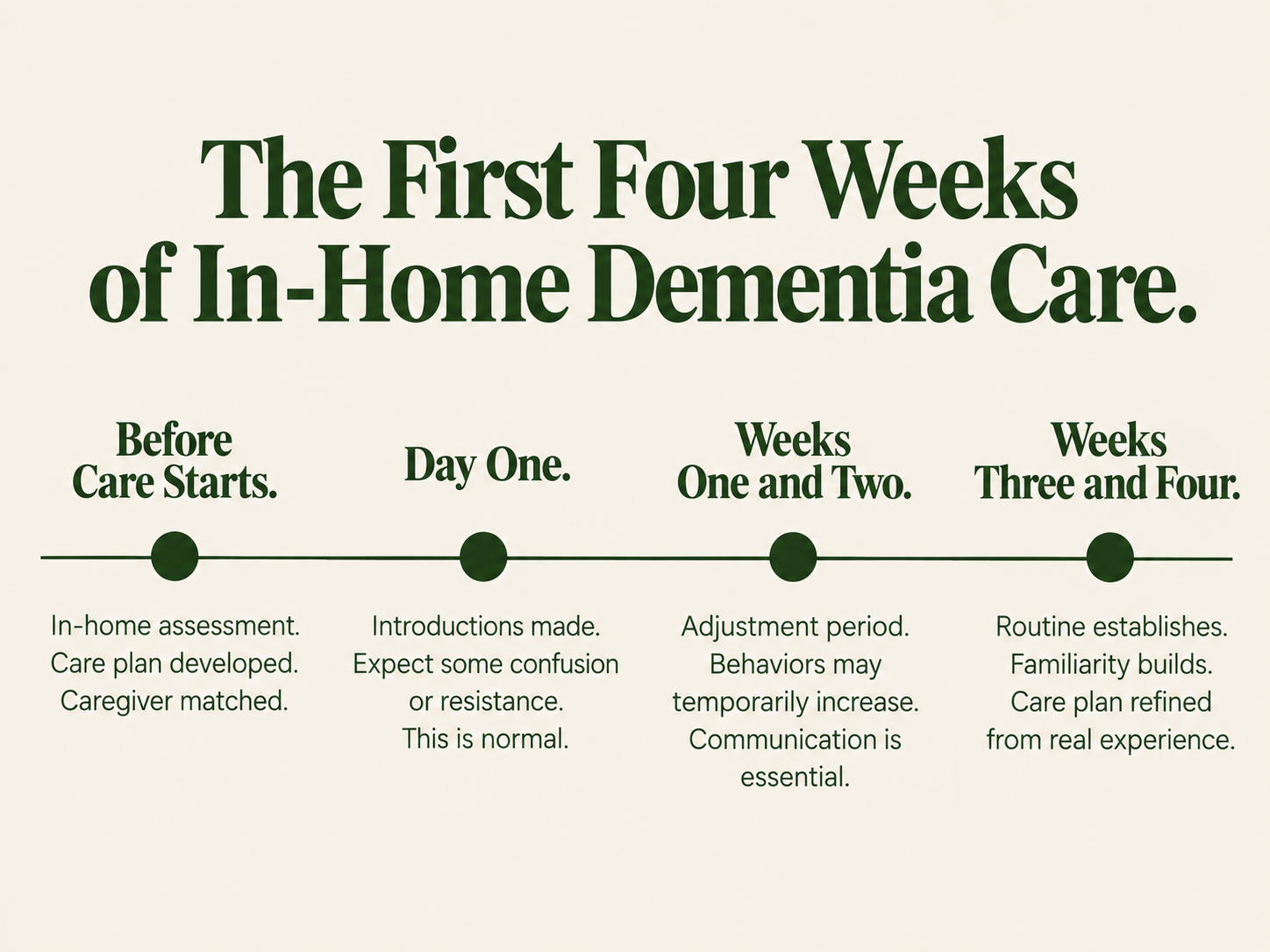
Before care starts: the assessment
A reputable dementia care agency does not begin care without first conducting a thorough in-home assessment. This is not a formality. It is the foundation on which everything else is built.
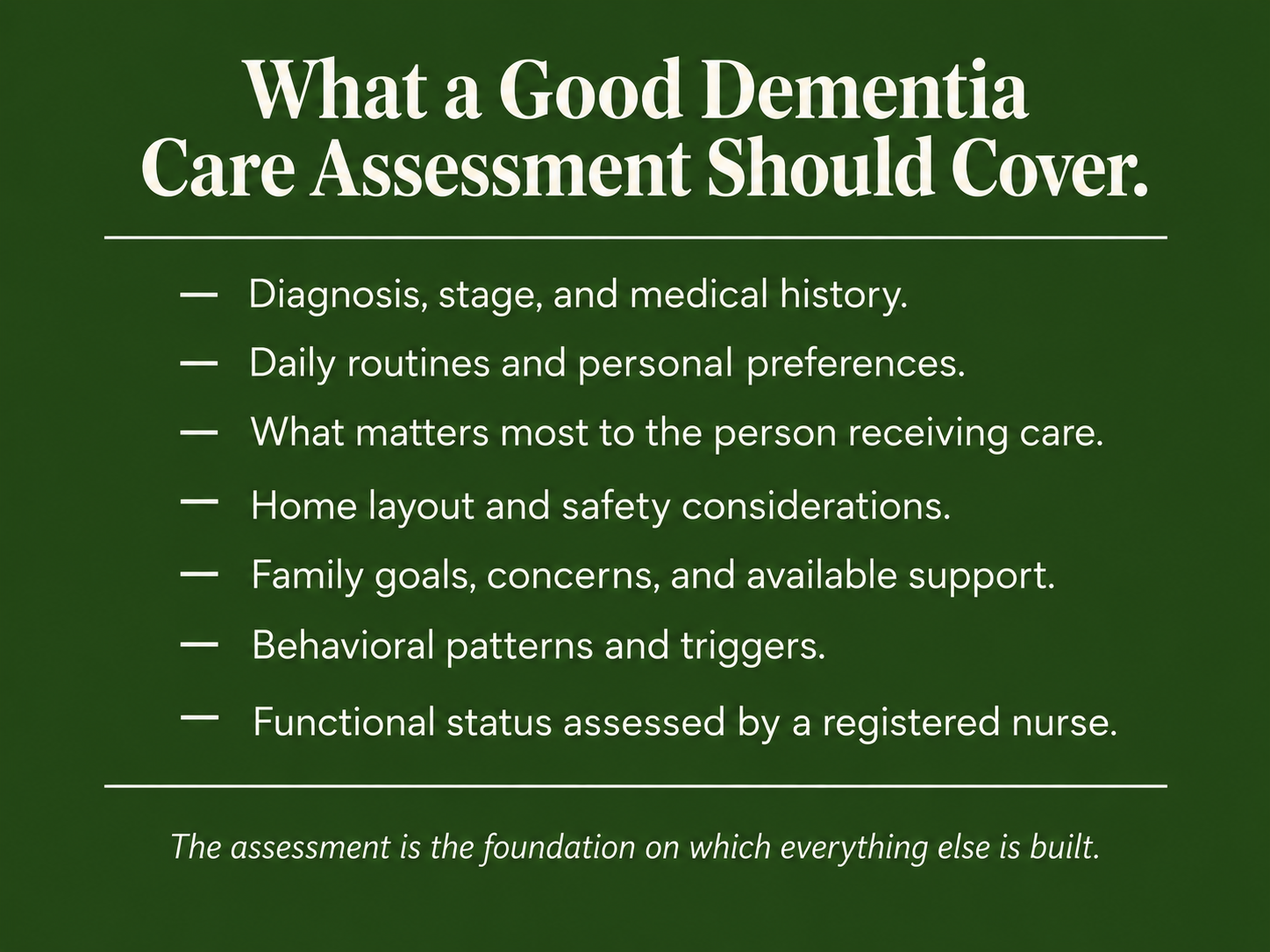
A good assessment covers the person's diagnosis and stage of disease, their history and daily routines, their preferences and what matters to them, the physical layout and safety of the home, the family's goals and concerns, and the specific tasks the caregiver will be expected to support. It should also involve a clinical component, ideally led by a registered nurse, that goes beyond scheduling logistics to assess the person's functional status, behavioral patterns, and medical needs.
At Guiding Light, this assessment is conducted by our RN Director of Care Services. The goal is to understand not just what care is needed but who this person is, so that we can build a care plan and match a caregiver accordingly. The information gathered in the assessment shapes every subsequent decision, from which caregiver is assigned to how the care plan evolves as the disease progresses.
Families should come to the assessment ready to share as much as they know. The more detail the care team has about the person's history, preferences, routines, and behavioral patterns, the better positioned they are to provide care that actually fits.
The caregiver match
One of the most consequential decisions an agency makes is which caregiver to assign to a new client. For people with dementia, this decision carries particular weight. Familiarity and consistency are not just pleasant features of good care. They are clinically meaningful. A person with dementia adjusts more easily to a caregiver they have come to recognize and trust, and that adjustment takes time.
A good agency thinks carefully about this match. Relevant factors include the caregiver's experience with the specific type and stage of dementia, their personality and communication style relative to the person they will be caring for, their schedule reliability, and practical considerations like commute and availability. An agency that assigns caregivers primarily on the basis of who is available is doing something fundamentally different from an agency that treats the match as a meaningful clinical and relational decision.
Ask your agency how they approach caregiver matching before care starts. A thoughtful answer is a good sign. A vague one is worth noting.
The first day
The first day of care is often more emotionally complex than families anticipate, for everyone involved.
For the person with dementia, a new face in the home is a significant change. Depending on the stage of disease and the person's temperament, they may be welcoming, curious, confused, resistant, or some combination of all of these at different points in the same day. Any of these responses is normal. Expecting a smooth, easy first day is setting an unrealistic standard.
For the family caregiver, the first day often brings an unexpected emotional response. Relief and guilt frequently arrive together. Watching someone else do what you have been doing, seeing your family member interact with a stranger, stepping back from a role that has consumed you, all of these can surface feelings that are hard to name. This is common and does not mean anything is wrong with the care arrangement or with you.
A few things that help on the first day:
Introduce the caregiver warmly
Your relationship with the person with dementia is an asset. A warm, calm introduction from you signals to them that this person is safe and welcome. If possible, be present for at least part of the first visit.
Do not disappear abruptly
Particularly if your family member has anxiety or significant confusion, an abrupt departure on the first day can increase distress. A gradual transition, where you are present and then step away for short periods before leaving entirely, tends to go more smoothly than a clean handoff.
Brief the caregiver in person
Even if the agency has shared assessment notes, a direct conversation between you and the caregiver before the first shift adds important context. Share the person's current mood, how the morning has gone, any recent changes, and anything the notes might not capture.
Let the caregiver work
Once introductions are made and context is shared, trust the caregiver to do their job. Hovering or intervening frequently makes it harder for the caregiver to build their own relationship with the person, and it can increase the person's confusion about who is in charge of the situation.
The first two weeks: what is normal
The adjustment period for in-home dementia care typically runs two to four weeks. During this period, families should expect some friction. What they should not expect is smooth, seamless care from day one. A care arrangement that looks perfect immediately is often one where the early difficulties are being managed quietly. More commonly, the first weeks involve some adjustment, some recalibration, and some learning on all sides.
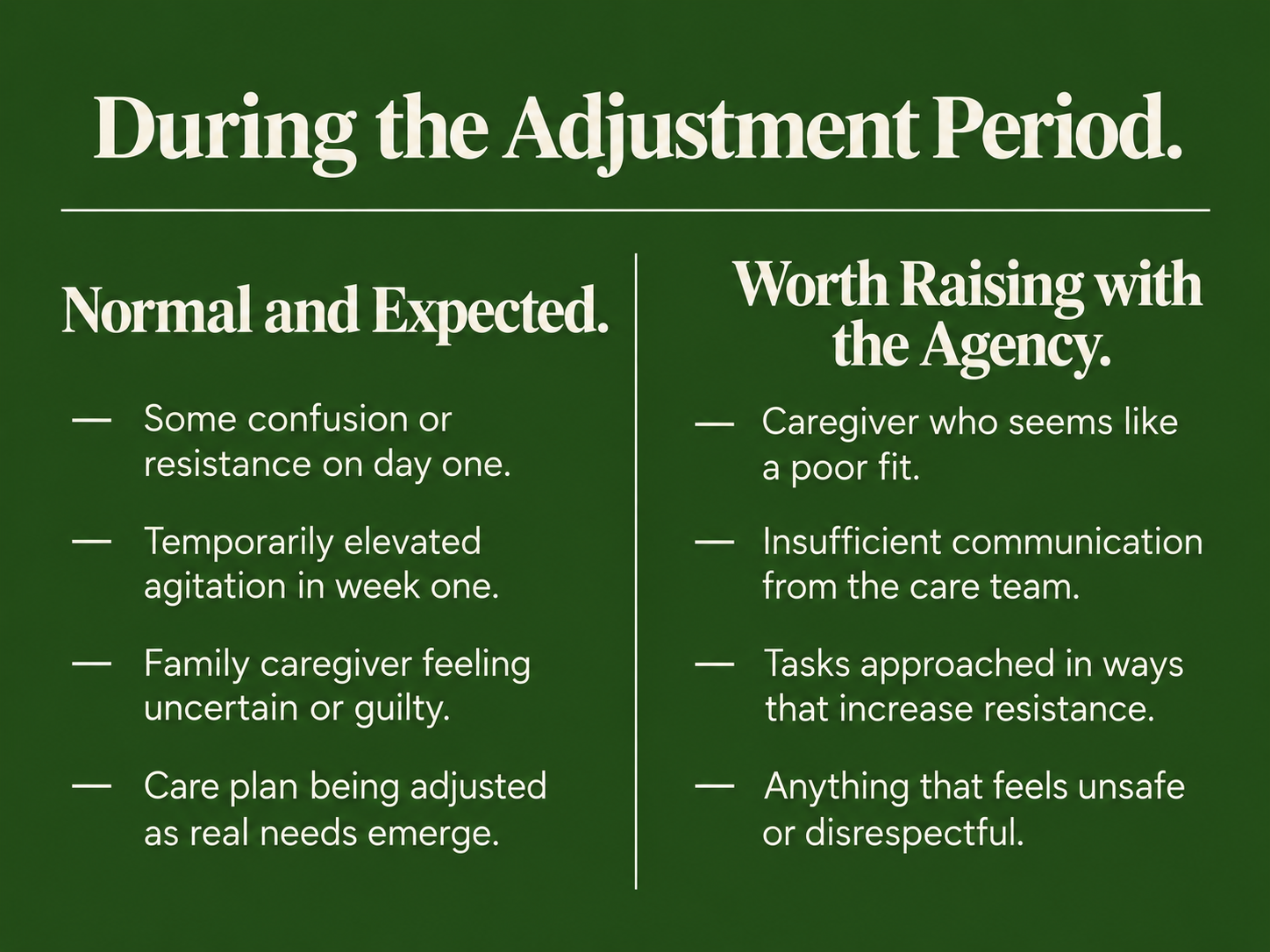
The person with dementia may resist or be confused
This is normal and does not necessarily mean the care is not working. People with dementia often take time to incorporate a new person into their sense of their environment. Resistance that is present in week one is frequently much reduced by week three, as the caregiver becomes familiar and the routine becomes established.
Behaviors may temporarily increase
It is not unusual for behavioral symptoms, including agitation, confusion, or resistance to care, to be somewhat elevated in the first week or two. The disruption of something new in the environment is a real stressor for someone whose brain can no longer process change easily. This typically settles as familiarity increases.
The family caregiver may feel uncertain
Even when care is going well, it is common for family caregivers to second-guess the decision, worry about whether the person is comfortable, and feel guilty about not being there. These feelings are not evidence that something is wrong. They are a normal part of the adjustment to a shared care model after a period of doing everything alone.
Communication will require active effort
The first weeks require more communication between the family and the care team than the ongoing arrangement will. Questions will come up. Observations will need to be shared. The family will want to know how visits are going, and the caregiver and agency will need feedback about what is and is not working. Building this communication habit early makes everything easier later.
What a good care team does in the first weeks
The agency's responsibility during the adjustment period is active, not passive. Dropping a caregiver off and checking in after a month is not good care management for a dementia client. Here is what a quality agency should be doing in the first weeks.
Checking in with the family
The agency should be in contact with the family during the first week, not just available if called. Early feedback is valuable and prevents small issues from becoming larger ones.
Reviewing caregiver notes
Most professional home care agencies use a care documentation system in which caregivers log what happened during each visit. The care management team should be reviewing these notes, looking for patterns, and following up on anything that warrants attention.
Assessing fit
The first weeks are the time to determine whether the caregiver match is working. A caregiver who is technically competent but not a good fit for a particular person is a real situation, and a good agency addresses it proactively rather than waiting for a family to raise it. If the match is not right, a quality agency will make a change without making the family feel that raising the concern was a problem.
Adjusting the care plan
The assessment-based care plan is a starting point, not a fixed document. The first weeks of actual care always surface information that the assessment did not fully capture. A good care team treats the care plan as a living document and adjusts it based on what is actually happening.
At Guiding Light, our RN Director of Care Services remains actively involved after care begins, not just during the assessment. That clinical oversight in the early weeks is one of the most valuable things we provide, precisely because the adjustment period is when small issues are easiest to address and when the care plan most needs to be refined in light of real experience.
When something is not working
Not every aspect of a new care arrangement will work perfectly, and families should feel confident raising concerns rather than waiting and hoping things improve on their own.
Common early issues include a caregiver whose approach is not quite right for the person's personality or stage of disease, a schedule that is not fitting the person's daily rhythms, tasks being approached in a way that causes unnecessary resistance, and communication between the family and the agency that feels insufficient.
These are all addressable, and a quality agency will want to hear about them. The instinct to avoid raising concerns for fear of seeming difficult, or of disrupting an arrangement that is mostly working, is understandable but counterproductive. Early course correction is almost always easier than later course correction.
The one situation that warrants escalation rather than a simple conversation is if you observe care that seems genuinely unsafe or disrespectful. That requires an immediate call to the agency's leadership, not a note in the communication log.
Building toward a sustainable arrangement
The goal of the first weeks is not just to survive the adjustment period. It is to build the foundation of a care relationship that can sustain the person and the family over what may be a long road ahead.
That foundation includes a caregiver who knows and understands the person they are caring for, a family caregiver who has begun to trust that their loved one is in good hands, a care plan that reflects what is actually working rather than what was assumed in the assessment, and a communication rhythm between the family and the care team that feels natural and reliable.
When these things are in place, in-home dementia care can provide something genuinely valuable: not just hands-on help, but a sustainable structure that allows the family caregiver to step back from crisis mode, reconnect with the person they love rather than only managing their care, and plan for the longer journey ahead with more confidence than they had before.
If you are considering starting care in the Triangle area
If you are in the Raleigh, Durham, Chapel Hill, Cary, Wake Forest, or surrounding Triangle area and are thinking about starting in-home dementia care, we are glad to answer questions and walk you through what our process looks like. A first conversation costs nothing and carries no obligation.
Reach us at (984) 205-2870 or GuidingLightCare.com.
Guiding Light Dementia Care provides specialized in-home dementia care in Raleigh, Durham, Chapel Hill, Cary, Wake Forest, and surrounding communities in the Triangle area of North Carolina.
Continue Reading