When Memory Care Isn't the Answer: Why Some Families Choose to Keep Care at Home
By David Hall, PhD, Founder & CEO, Guiding Light Dementia Care
At some point in the dementia journey, most families find themselves asking the same question: Is it time to look at a memory care facility?
It's a reasonable question, and it deserves an honest answer — not a sales pitch, and not a reflexive reassurance that home is always best. The truth is that memory care facilities are the right answer for some families, at some stages, in some circumstances. And in-home care is the right answer for others. The goal of this article is to help families think through that distinction clearly, before a crisis forces the decision.
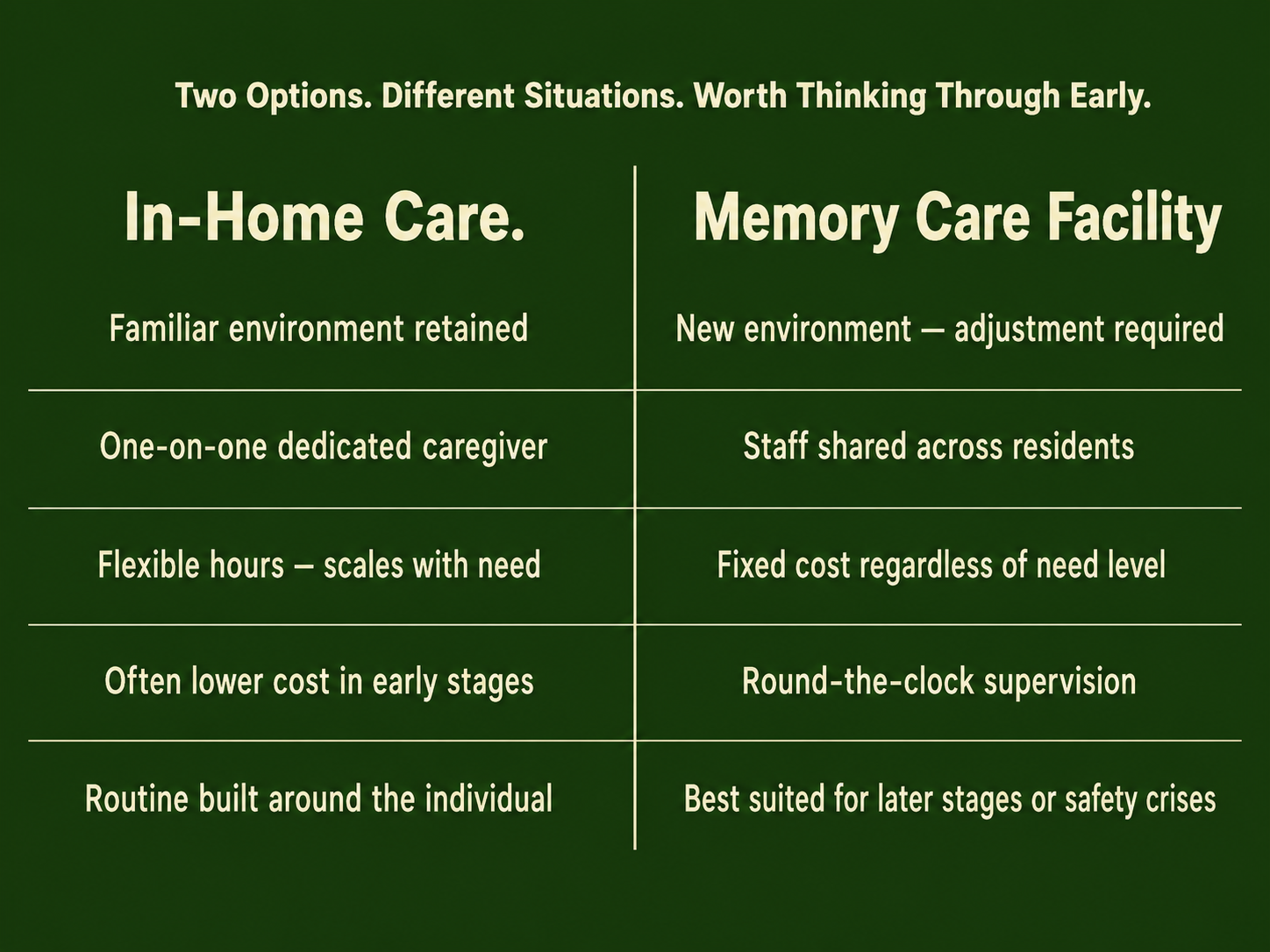
What memory care facilities actually offer
Memory care facilities are residential care settings designed specifically for people with dementia. They provide round-the-clock supervision in a structured environment with staff trained in dementia care, secured perimeters to prevent wandering, and programming designed for this population. In many cases they offer a level of medical oversight and peer community that in-home care cannot replicate.
They are appropriate — and often the best option — when a person needs more supervision than can reasonably be provided at home, when the home environment has become genuinely unsafe, when a family caregiver has reached the limits of their physical or emotional capacity, or when the disease has progressed to a point where the intensity of care required exceeds what in-home support can provide.
Memory care is not a failure. For many families, it is a thoughtful and loving decision made at the right time for the right reasons. The question worth sitting with is whether the right time has actually arrived — or whether it's being considered because it feels like the only option when, in fact, it isn't.
Why families consider memory care before they need it
Several forces push families toward memory care earlier than may be necessary.
The care crisis problem
Most families don't start planning for dementia care until a crisis arrives — a fall, a hospitalization, a wandering incident, a caregiver who can no longer continue. At that point, decisions get made under pressure, with limited time to evaluate options carefully. Memory care facilities have physical infrastructure to visit, brochures to review, and staff ready to guide a tour. They feel like a concrete solution when families desperately need one. In-home care, by contrast, feels more abstract and harder to evaluate quickly. This is a structural advantage for memory care in crisis situations that has nothing to do with which option is actually better for the person.
The assumption that home is no longer safe
Safety concerns are one of the most common reasons families begin exploring memory care, and they're legitimate. Dementia does create real safety risks. But the relevant question is whether those risks are better managed by moving to a facility or by modifying the home environment and adding appropriate supervision. For many families, the answer is the latter — at least for a meaningful period of time. A home safety assessment by a qualified dementia care professional can often identify specific, addressable risks and solutions that make continued home care genuinely viable.
Caregiver exhaustion
When a family caregiver — a spouse, an adult child — has been providing primary care without adequate support, exhaustion eventually reaches a breaking point. At that point, memory care can feel like the only way to get relief. What's worth knowing is that professional in-home care can provide that relief without requiring a move. Bringing in trained caregivers for regular shifts gives the family caregiver time to rest, recover, and sustain the caregiving relationship over a longer period. The exhaustion is real and needs to be addressed — but it doesn't always mean a facility is the only answer.
What the research says about familiar environments
One of the most consistent findings in dementia care research is that familiar environments reduce anxiety and behavioral symptoms in people with dementia. The home — with its familiar layout, familiar objects, familiar sounds and smells — provides a form of orientation that a new environment cannot replicate, regardless of how thoughtfully that new environment is designed.
This matters most in the mild to moderate stages of dementia, when a person retains enough awareness to register the difference between familiar and unfamiliar surroundings. It also matters for behavioral symptoms: agitation, anxiety, and resistance to care are often worse in unfamiliar environments, particularly during the adjustment period following a move. For some people, the transition to a memory care facility — even a high-quality one — produces a period of significant behavioral deterioration before stabilization occurs.
"The familiarity of home is a genuine asset worth weighing, not a sentimental consideration to set aside in favor of a more clinical calculation."
None of this means that the familiar environment of home is always better than the structured environment of a memory care facility. It means that the familiarity of home is a genuine asset worth weighing, not a sentimental consideration to set aside in favor of a more clinical calculation.
What good in-home dementia care actually makes possible
When families imagine in-home care, they sometimes picture a basic companion or aide — someone to keep their loved one company and help with a few tasks. Specialized dementia home care is something more than that.
A well-designed in-home care program provides:
- Trained caregivers who understand the behavioral and communication dimensions of dementia
- A consistent care team that the person with dementia comes to recognize and trust
- A structured routine tailored to the individual's preferences and stage of disease
- Clinical oversight that monitors for changes and adjusts the care plan over time
- Coordination with the family that keeps everyone informed and supported
This kind of care can support a person with dementia at home through stages that many families assume require a facility. It can provide overnight care for families concerned about nighttime safety. It can support a family caregiver in ways that prevent the exhaustion-driven crisis described above. And it can extend the period when living at home is genuinely workable — sometimes by years.
The honest caveat is that in-home care is not infinitely scalable. There are stages of dementia — typically later stages involving significant physical decline, complex medical needs, or safety risks that require constant supervision — at which the transition to a higher level of care becomes genuinely necessary. A good dementia care professional will tell you honestly when that point is approaching, rather than prolonging in-home care past the point where it serves the person's best interests.
The financial comparison families don't always make
Cost is a significant factor in this decision, and it's worth looking at clearly.
Memory care facilities in the Raleigh and Triangle area typically cost between $5,000 and $8,000 per month, depending on the community, the level of care, and the size of the living space. Higher-end memory care facilities can cost substantially more. That cost is relatively fixed once a person moves in — it doesn't scale up or down with changing needs in the way in-home care hours can.
In-home dementia care costs depend almost entirely on hours. A family arranging 20 to 30 hours of in-home care per week is typically looking at $3,000 to $5,000 per month in the Triangle market — meaningfully less than memory care at that level of support. As hours increase toward full-time coverage, in-home care costs approach and can exceed memory care costs, particularly for 24/7 live-in arrangements.
This means that in the earlier and middle stages of dementia, when part-time in-home support is sufficient, in-home care is often the more affordable option — and the one that keeps the person in a familiar environment. The financial calculation changes as care needs intensify. Understanding this trajectory in advance helps families make better decisions rather than reactive ones.
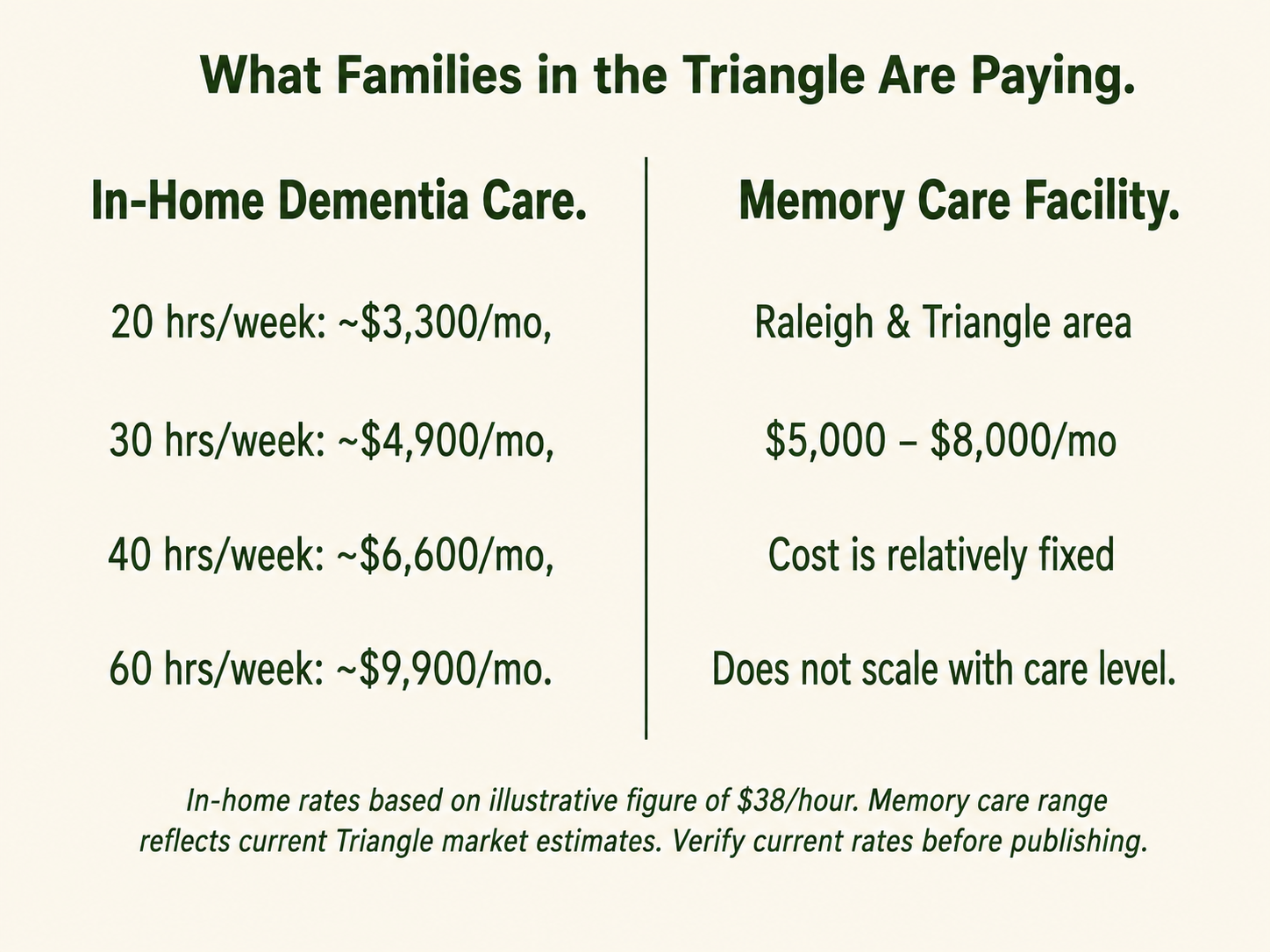
In-home rates scale with hours; memory care costs are relatively fixed regardless of care level.
Questions worth asking before making the decision
If your family is weighing these options, here are the questions worth sitting with before deciding.
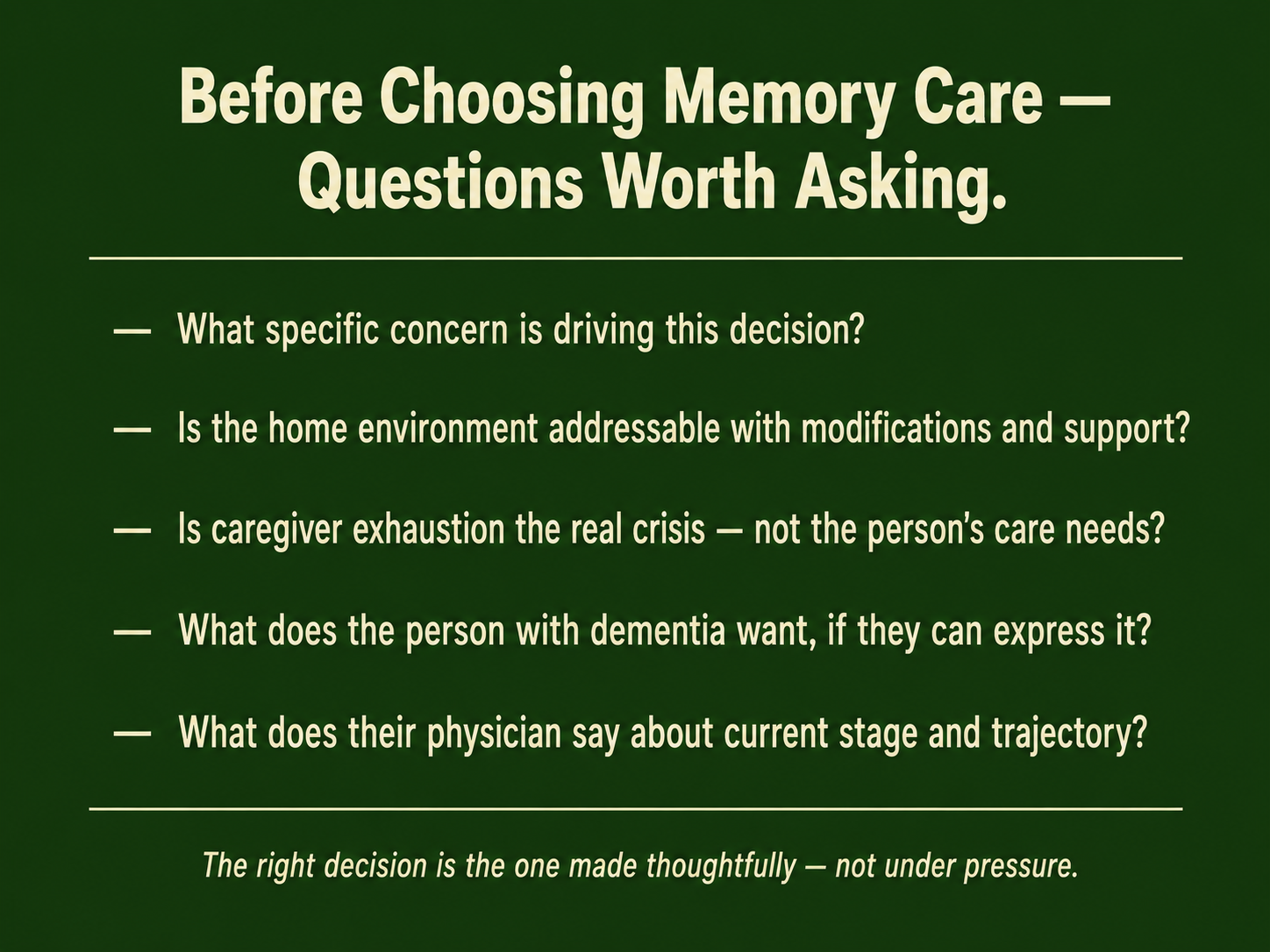
What specific concerns are driving the consideration of memory care — safety, supervision, caregiver exhaustion, or something else? Are those concerns addressable with better in-home support, or do they genuinely require a residential setting?
What does the person with dementia want, to the extent they can express a preference? Their voice, even when it's harder to access, matters in this decision.
Has a professional home safety assessment been done? Many safety concerns that feel insurmountable are specifically addressable with environmental modifications and appropriate supervision.
Is the family caregiver getting enough support? If the crisis is caregiver exhaustion rather than the person's care needs outpacing what home can provide, the solution may be additional in-home support rather than a facility.
What does the person's neurologist or primary care physician think about their current stage and likely trajectory? Understanding the disease's progression helps families plan for the right horizon, not just the immediate moment.
A note on having this conversation
At Guiding Light Dementia Care, we're willing to have this conversation honestly — including when the answer might be that in-home care isn't the right fit. Our goal is to help families make the decision that's actually best for their loved one, not to advocate for one care setting over another regardless of the circumstances.
If you're in the Raleigh, Durham, Chapel Hill, Cary, Wake Forest, or surrounding Triangle area and trying to think through this decision, we're glad to talk. An honest conversation costs nothing, and it may help clarify a decision that feels much harder than it has to be.
Guiding Light Dementia Care provides specialized in-home dementia care in Raleigh, Durham, Chapel Hill, Cary, Wake Forest, and surrounding communities in the Triangle area of North Carolina.
Continue Reading