The Real Cost of Dementia Home Care: What Families in the Triangle Are Paying
By David Hall, PhD, Founder & CEO, Guiding Light Dementia Care
One of the first questions families ask when they start looking into dementia home care is also one of the hardest to get a straight answer on: what does it actually cost?
The difficulty isn't that agencies are hiding the number. It's that the answer depends on more variables than most families expect — how many hours of care are needed, what level of specialization the agency provides, whether clinical oversight is built into the model, and how care needs change as the disease progresses. Add to that the confusion around what Medicare does and doesn't cover, and it's easy to understand why families often feel like they're trying to plan for something nobody will give them clear information about.
This article is an attempt to give Triangle families a clear, honest picture of what dementia home care costs, how those costs are typically structured, and where the money to pay for it actually comes from.
How home care is priced
Home care is almost universally billed by the hour. You pay for the hours a caregiver is in your home — not a flat monthly fee, not a per-visit charge, not a bundled package. That hourly rate multiplied by the number of hours per week is your weekly cost, and that weekly cost is the number worth planning around.
Most agencies have minimum shift lengths — commonly two, three, or four hours per visit. This means that even if you only need an hour of help with a specific task, you'll typically be billed for the minimum shift. It also means that scheduling a single one-hour morning visit is not usually how home care works in practice; care plans are typically designed around meaningful shifts that make efficient use of caregiver time and provide genuine continuity for the person receiving care.
Hours can range from a few hours a week for light support to round-the-clock care for someone who can no longer safely be left alone. Most families land somewhere in between, often starting with fewer hours and increasing as needs grow.
What dementia home care costs in the Raleigh and Triangle area
Hourly rates for in-home dementia care in the Raleigh, Durham, and Chapel Hill area generally range from the mid-$30s to the mid-$40s per hour. Where a specific agency falls within that range depends on several factors.
Level of specialization matters significantly. A dementia-specific agency that invests in rigorous caregiver training, intentional caregiver-client matching, and ongoing clinical oversight typically charges more than a general home care agency offering dementia care as one service among many. That difference in cost reflects a difference in what you're getting — training infrastructure, caregiver quality, and a care model built specifically for this population.
Clinical oversight is a meaningful cost driver. Agencies that include active RN involvement in care planning and ongoing assessment — not just as a compliance checkbox but as a genuine part of the care model — carry higher operating costs that are reflected in their rates. For families managing dementia, that clinical layer adds real value, but it's worth understanding that you're paying for it.
Geography and market play a role as well. Rates in Raleigh and Durham tend to be consistent with each other; smaller surrounding communities may see some variation. Shift timing also affects cost at some agencies — overnight care, weekend shifts, and holiday coverage sometimes carry a premium over standard daytime weekday rates.
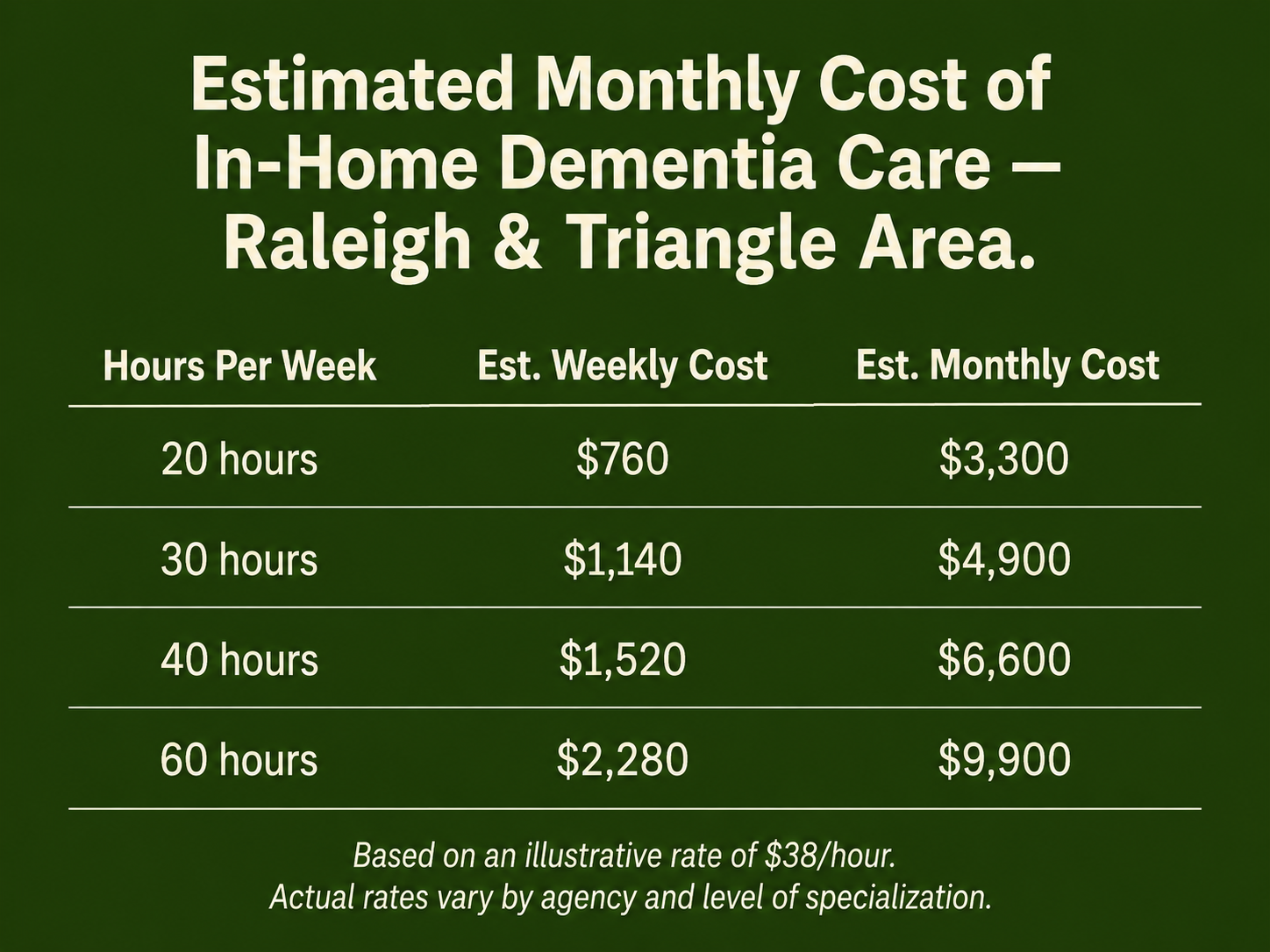
Estimated monthly costs based on an illustrative rate of $38/hour. Actual rates vary by agency and level of specialization.
To put this in concrete terms: a family arranging 20 hours of dementia home care per week at $38 per hour is looking at approximately $760 per week, or roughly $3,300 per month. At 40 hours per week, that same rate produces approximately $1,520 per week, or around $6,600 per month. These are planning numbers — your actual costs will depend on your specific situation — but they give a sense of the order of magnitude families are navigating.
What Medicare covers — and what it doesn't
This is the single most important clarification in this entire article, and the one that catches the most families off guard: Medicare does not cover ongoing in-home dementia care.
Medicare is a health insurance program. It covers skilled medical services — a nurse coming to administer medication, a physical therapist providing rehabilitation, a wound care specialist following surgery. It covers short-term recovery care following a hospitalization, under specific conditions and for a limited duration. What it does not cover is the ongoing personal care and supervision that dementia requires — help with bathing, dressing, meals, safety monitoring, and the daily support that allows someone with dementia to remain at home.
This distinction between skilled medical care and personal care is the source of enormous confusion and, for many families, a painful surprise. Families who have dutifully paid Medicare taxes for decades and assumed they were covered for exactly this kind of need often discover the gap only when the need arrives.
Medicaid is different from Medicare and does cover some personal care services for qualifying individuals, but eligibility is means-tested and the scope of coverage varies. We cover Medicaid options in more detail below.
How families actually pay for dementia home care
Without Medicare coverage, families turn to a combination of other sources. Here is an honest picture of what's available.
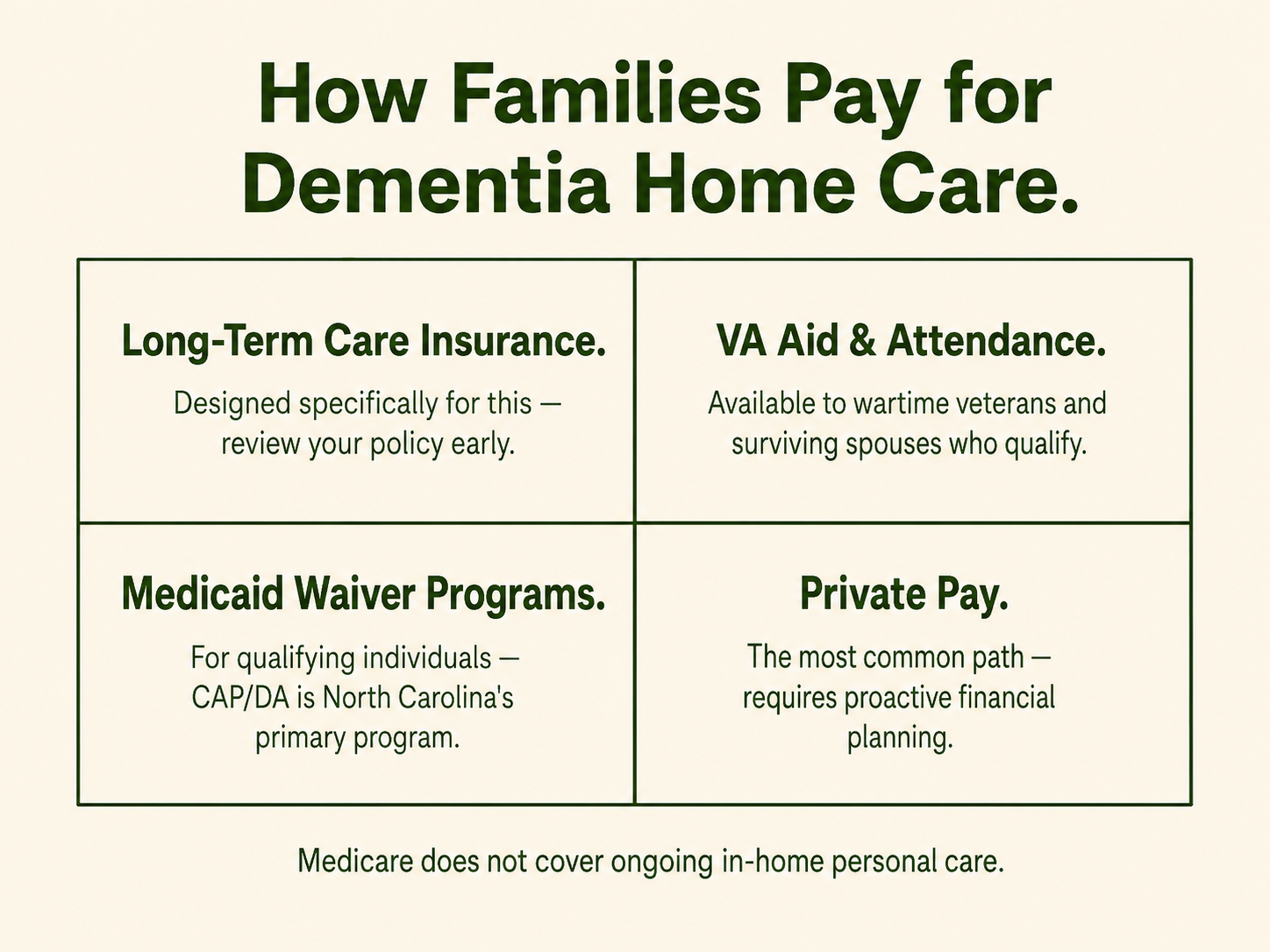
The four primary funding sources families use to cover in-home dementia care costs. Medicare does not cover ongoing personal care.
Long-term care insurance
Long-term care (LTC) insurance was designed specifically for this situation — covering the cost of in-home care, assisted living, or nursing home care for people who need help with activities of daily living. If your family member purchased an LTC policy, this is the first thing to review.
Policies vary enormously in what they cover, what daily or monthly benefit they pay, and what conditions trigger benefits. Most policies require that the person need help with a defined number of activities of daily living (ADLs) or have a cognitive impairment — which dementia typically satisfies — before benefits begin. There is often a waiting period (called an elimination period) of 30 to 90 days before the policy pays out, during which the family covers costs out of pocket.
Review the policy carefully and early — before a care need becomes urgent. If you're not sure what the policy covers, a benefits counselor or elder law attorney can help you read it correctly.
VA Aid and Attendance
The VA Aid and Attendance benefit is one of the most underutilized financial resources available to families paying for long-term care. It is available to wartime veterans and their surviving spouses who need help with daily activities and meet income and asset requirements.
Monthly benefit amounts vary depending on whether the applicant is a veteran, a surviving spouse, or a couple, but they can be substantial — potentially covering a meaningful portion of home care costs. The application process can be complex and slow, which is part of why families don't always pursue it, but the benefit is worth the effort for families who qualify.
If you believe your family member may be eligible, contact your local VA office or work with an accredited VA claims agent or elder law attorney who handles VA benefits. Starting the process early is important, as approval can take months.
Medicaid waiver programs
Medicaid covers long-term care services for individuals who meet financial eligibility requirements — meaning limited income and assets. In North Carolina, the primary program that funds in-home care for older adults with dementia is the Community Alternatives Program for Disabled Adults (CAP/DA), a Medicaid waiver program that provides home and community-based services as an alternative to nursing home placement.
CAP/DA can cover personal care, supervision, and other in-home services for qualifying individuals. Eligibility requires both a clinical determination of need and financial eligibility under Medicaid income and asset limits. There are often waiting lists, and the scope of covered services may differ from what a private-pay agency offers. A social worker, aging life care manager, or Medicaid planning attorney can help you assess eligibility and navigate the application process.
Private pay
Private pay — using personal savings, retirement funds, investment accounts, or family contributions — is the most common funding source for families who don't have long-term care insurance and don't qualify for Medicaid. It offers the most flexibility and the fewest restrictions on choosing an agency or structuring a care plan, but it requires careful financial planning to sustain over time.
For families using private pay, it's worth having an honest conversation with a financial advisor about how long current assets can support care at the level needed, and what adjustments might be required as care needs intensify. Dementia care costs typically increase over the course of the disease as hours of care go up, and planning for that trajectory is more useful than planning only for current needs.
Life insurance and other options
Some families are not aware that life insurance policies can sometimes be accessed for long-term care costs. Depending on the policy, options may include accelerated death benefits (available if the insured has a qualifying terminal or chronic illness), life settlements (selling the policy to a third party for a lump sum), or policy loans. These options vary significantly by policy and circumstance and are worth discussing with a financial advisor or elder law attorney.
Planning for costs over time
One of the most important things to understand about dementia home care costs is that they are not static. Dementia is progressive, and care needs — and therefore care costs — typically increase as the disease advances. A family that needs 15 hours of care per week in year one may need 40 or more hours per week two years later, and eventually full-time care as independence decreases.
This means that financial planning for dementia home care is not a one-time calculation. It's an ongoing assessment that needs to account for the likely trajectory of the disease, the funding sources available at different stages, and the point at which in-home care may give way to a higher level of care.
Families who plan this trajectory in advance — even roughly — make better decisions and have more options than families who plan only for immediate needs. A geriatric care manager or aging life care manager can be a useful resource for this kind of planning, particularly when combined with input from a financial advisor or elder law attorney.
A Note on Transparency
We believe families deserve clear, honest information about cost.
Not a number revealed only after several conversations, and not a rate sheet buried in fine print. If you're trying to understand whether specialized in-home dementia care in the Triangle is financially workable for your family, we're glad to have that conversation directly. We serve families in Raleigh, Durham, Chapel Hill, Cary, Wake Forest, and surrounding communities.
Continue Reading