There is a particular kind of grief that comes with the holidays when someone you love has dementia. It is not the grief of loss in the way most people understand it, because the person is still here. They are sitting at the table. They may be smiling. And yet something is missing, or changed, or harder than it used to be, in ways that are difficult to name and even harder to explain to family members who are not around every day.
This article is for the families who are living that reality this season. It covers what makes the holidays genuinely difficult for people with dementia and their caregivers, how to adjust expectations in ways that protect everyone, how to handle family members who may not understand what has changed, and how to find something real and meaningful in a holiday that looks different than it used to.
Why the holidays are especially hard with dementia
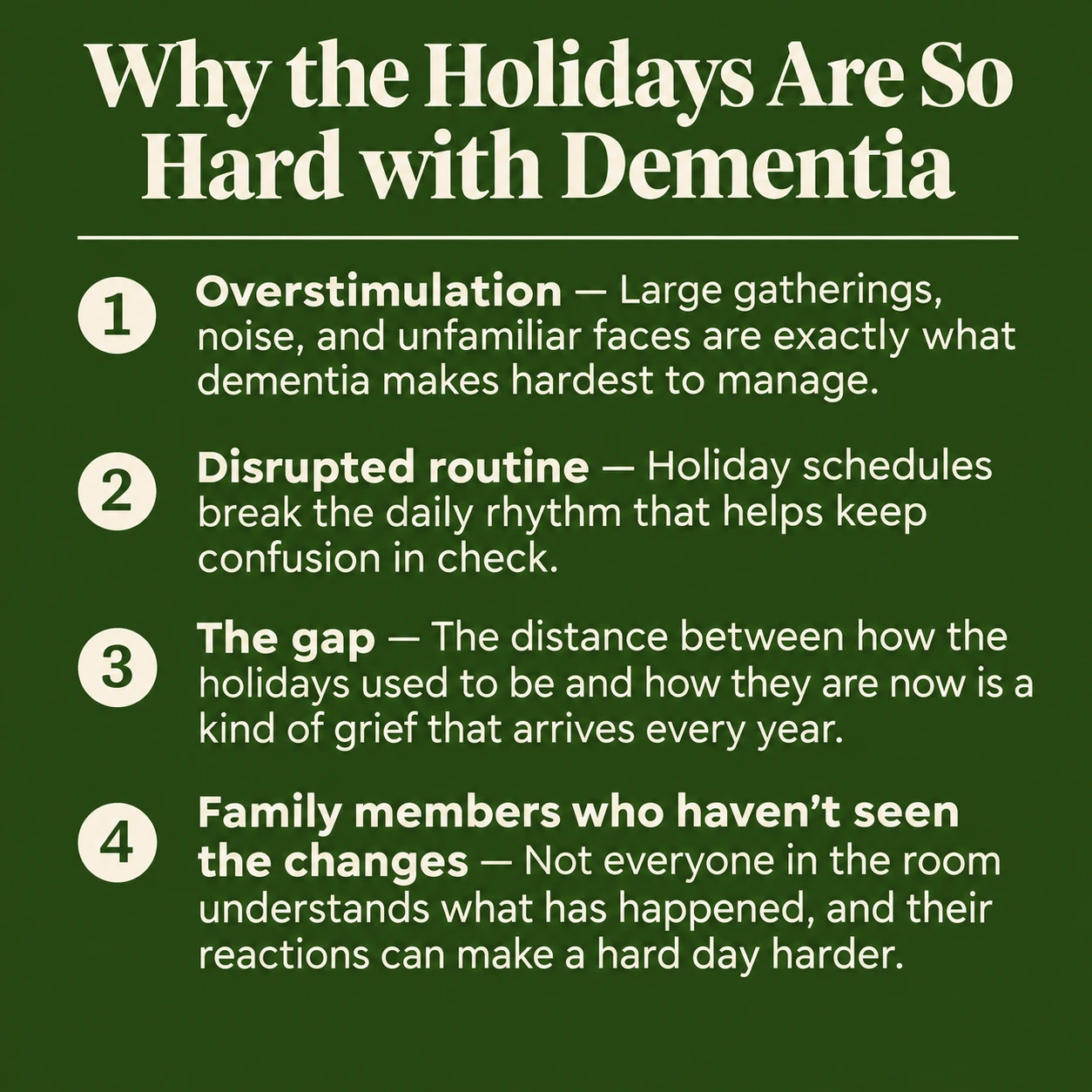
The holidays ask a great deal of people with dementia, often without anyone intending it.
The typical holiday environment, large family gatherings, unfamiliar guests, disrupted routines, travel, elevated noise and activity, is precisely the kind of environment that is most difficult for someone whose brain can no longer process change and complexity easily. The stimulation that feels festive to everyone else can feel overwhelming and threatening to someone with dementia. The confusion that might be manageable on a quiet Tuesday becomes much harder to navigate in a room full of relatives asking questions and expecting recognition.
Add to this the fact that holiday routines are different from everyday routines, and routine is one of the most important sources of stability for people with dementia. A change in mealtimes, sleeping arrangements, or the familiar pattern of the day can be genuinely disorienting in ways that show up as agitation, withdrawal, or behavioral symptoms that catch family members off guard.
And there is the emotional weight of the gap, the distance between the holiday as it was and the holiday as it is now. That gap is real, and it accumulates. Each year it may be a little wider. The person with dementia may not be able to participate in traditions that defined the season for decades. They may not recognize relatives they once loved. They may become distressed at the dinner table in a way that shifts the mood of the room. These moments are painful for everyone, and the pain does not get easier to carry simply because it is expected.
Adjusting expectations: the most useful thing you can do
The single most helpful thing families can do before the holidays arrive is to decide, explicitly and together, that this year's holiday does not have to look like past years. That sounds simple. It is not, because the pressure to maintain traditions is real, and the grief of letting them go is real too.
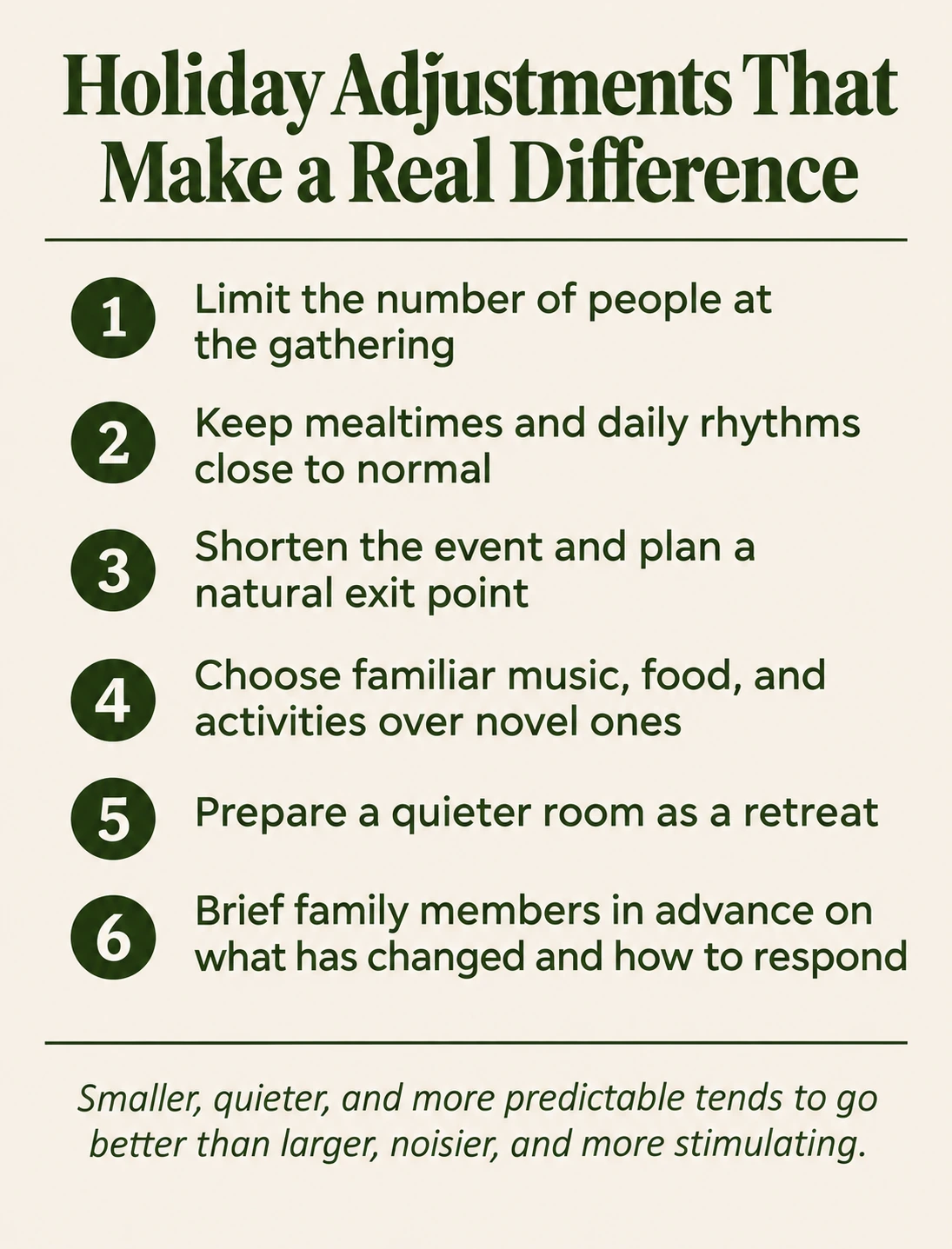
But the alternative, trying to recreate a holiday that the person with dementia can no longer fully participate in and hoping it will go well, tends to produce disappointment, exhaustion, and difficult moments that cast a shadow over the whole day. Smaller, quieter, and more predictable tends to go better than larger, noisier, and more stimulating.
A few specific adjustments that make a meaningful difference:
Limit the number of people
A gathering of four or six is manageable for most people with dementia in ways that a gathering of twenty is not. If the larger family tradition is important to others, consider separating the celebrations: a smaller gathering centered around the person with dementia, and a larger gathering that other family members can attend separately.
Keep the timing familiar
If the person typically eats dinner at five-thirty, a holiday dinner at seven-thirty is a disruption that will register even if the person cannot articulate it. Keeping mealtimes, rest times, and the overall rhythm of the day as close to normal as possible reduces the cumulative load of unfamiliarity.
Shorten the event
A two-hour gathering that ends on a good note is better than a five-hour gathering that ends in exhaustion and distress. Build in a natural exit point.
Choose familiar over elaborate
The music, the food, the decorations, the activities: familiar versions of these things are more likely to reach the person with dementia and produce genuine pleasure than elaborate or unfamiliar ones. A song they have always loved at Christmas does more than a novel holiday experience.
Prepare the environment
Reduce noise where possible. Keep one quieter room available as a retreat. Make sure the space is safe and that the person is not left without orientation support when things get busy.
Talking to family members who haven't seen the changes
One of the hardest parts of a holiday gathering is managing the reactions of family members who live at a distance and have not witnessed the progression of the disease. They may arrive expecting the person they knew and encounter someone significantly changed. That shock can express itself as denial, as grief, as frustration, or as well-meaning behavior that is actually unhelpful, pressing the person to remember, asking rapid-fire questions, drawing attention to what they cannot do.
A brief, honest conversation with family members before they arrive goes a long way. Some things worth covering:
What has changed and what has not. Be specific. Not just "she's gotten worse" but "she may not recognize you at first, and it helps to introduce yourself by name and your relationship to her rather than waiting to be recognized."
What to do instead of what comes naturally. The instinct to quiz, to remind, to correct, to insist is understandable and almost always counterproductive. Tell family members that if she says something that is not accurate, it is fine to let it go. That if she asks the same question several times, answering warmly each time is the right response. That the goal is not for her to perform correctly but for her to feel safe and loved.
What to expect emotionally. If she might become distressed or confused, say so in advance. Family members who are prepared for that possibility handle it more gracefully than those who are caught off guard.
This conversation is not easy to have. But it protects the person with dementia from interactions that are disorienting and distressing, and it protects family members from a painful experience they did not expect.
When a family member says something painful
It is common at holiday gatherings for a person with dementia to say something that is heartbreaking for the people who love them: not recognizing a child or grandchild, asking for someone who has died, expressing fear or confusion in front of the whole family, saying something that reveals how much has changed.
These moments happen. They are not emergencies, though they can feel like one. A few things help.
Stay calm. The emotional temperature of the room matters more than the content of the moment. A family that absorbs the moment without panic gives the person with dementia a cue that nothing terrible has happened.
Respond to the feeling, not the content. If she is asking for her mother, who died forty years ago, she is expressing a need for comfort and safety. Meeting that need, with warmth, touch, a calm voice, matters more than correcting the factual error.
Give people something to do. Family members who feel helpless at difficult moments do better when they have a role. Someone can sit with her quietly. Someone can offer something familiar. Action is easier than witness.
And give yourself permission to grieve privately. The holidays surface losses that the rest of the year allows you to manage in smaller doses. You do not have to be entirely composed in the face of that. The grief of watching someone you love move through dementia is real and it deserves acknowledgment, even if the acknowledgment happens after the gathering rather than during it.
Finding something real in a different kind of holiday
The question underneath all of this is whether the holidays can still mean something when the person you love has changed so much.
The honest answer is: yes, but differently.
What tends to remain longest in people with dementia is emotional memory, the felt sense of safety, warmth, love, and belonging, even when the factual memories that used to carry those feelings have faded. A person who cannot remember that it is Christmas may still feel the warmth of being surrounded by people who love them, the pleasure of familiar music, the comfort of a known smell from the kitchen. Those things reach them even when the narrative of the holiday does not.
The holidays do not have to be what they were to be real. They can be smaller, quieter, and built around what still works rather than what used to work. That is not a lesser holiday. It is a different one, shaped by where you actually are rather than where you wish you were. And for many families, those smaller, quieter moments become some of the most tender ones they will remember.
If the holidays are revealing that you need more support
The holidays have a way of making visible what has been manageable the rest of the year. If the gathering this season is showing your family how much has changed, or if you are heading into the season already exhausted, it may be a good time to think about what additional support might look like.
At Guiding Light Dementia Care, we work exclusively with dementia families in Raleigh, Durham, Chapel Hill, Cary, Wake Forest, and the surrounding Triangle area. Our RN Director of Care Services and our trained caregivers have supported many families through the holiday season and the care transitions that often follow it.
If you would like to talk through what support might look like for your family, we are glad to have that conversation. Reach us at (984) 205-2870 or GuidingLightCare.com.
Guiding Light Dementia Care provides specialized in-home dementia care in Raleigh, Durham, Chapel Hill, Cary, Wake Forest, and surrounding communities in the Triangle area of North Carolina.
Continue Reading