Frontotemporal Dementia: A Guide for Families Navigating an Unfamiliar Diagnosis
By David Hall, PhD, Founder & CEO, Guiding Light Dementia Care
Most people have heard of Alzheimer's disease. Far fewer have heard of frontotemporal dementia, even though it is one of the most common causes of dementia in people under 60. For families receiving this diagnosis, that unfamiliarity is part of what makes it so disorienting — there is no broad cultural understanding to lean on, and much of what people think they know about dementia doesn't apply.
This guide is meant to help families understand what frontotemporal dementia actually is, how it differs from other forms of dementia, and what thoughtful care looks like.
What is frontotemporal dementia?
Frontotemporal dementia (FTD) refers to a group of disorders caused by progressive damage to the frontal and temporal lobes of the brain — the regions responsible for personality, behavior, judgment, and language. Unlike Alzheimer's disease, which typically begins by affecting memory, FTD often leaves memory relatively intact in its early stages while dramatically altering personality, behavior, or language.
FTD is not a single disease but a spectrum of related conditions. The two main categories are behavioral variant FTD, which primarily affects personality and conduct, and primary progressive aphasia, which primarily affects language. Some forms of FTD also involve motor symptoms similar to Parkinson's disease or ALS.
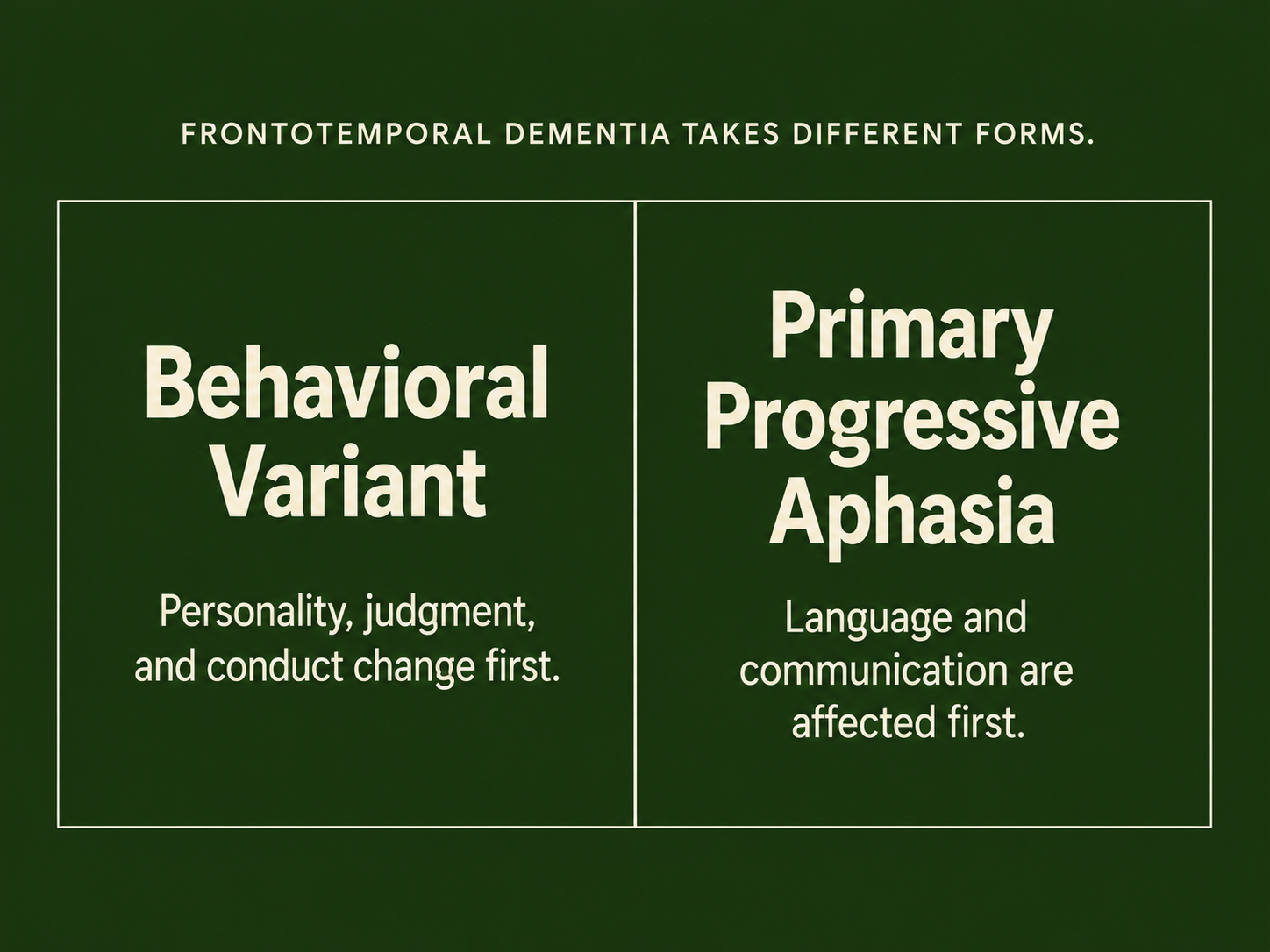
Frontotemporal dementia takes different forms, affecting behavior or language depending on the subtype.
FTD is notable for affecting people at a younger age than most dementias. Most FTD cases occur between ages 45 and 64, meaning it frequently strikes people who are still working, still raising children, and not at all expecting a diagnosis associated with old age. This has consequences that ripple through every part of a family's life — finances, parenting, marriage, identity.
How frontotemporal dementia differs from Alzheimer's
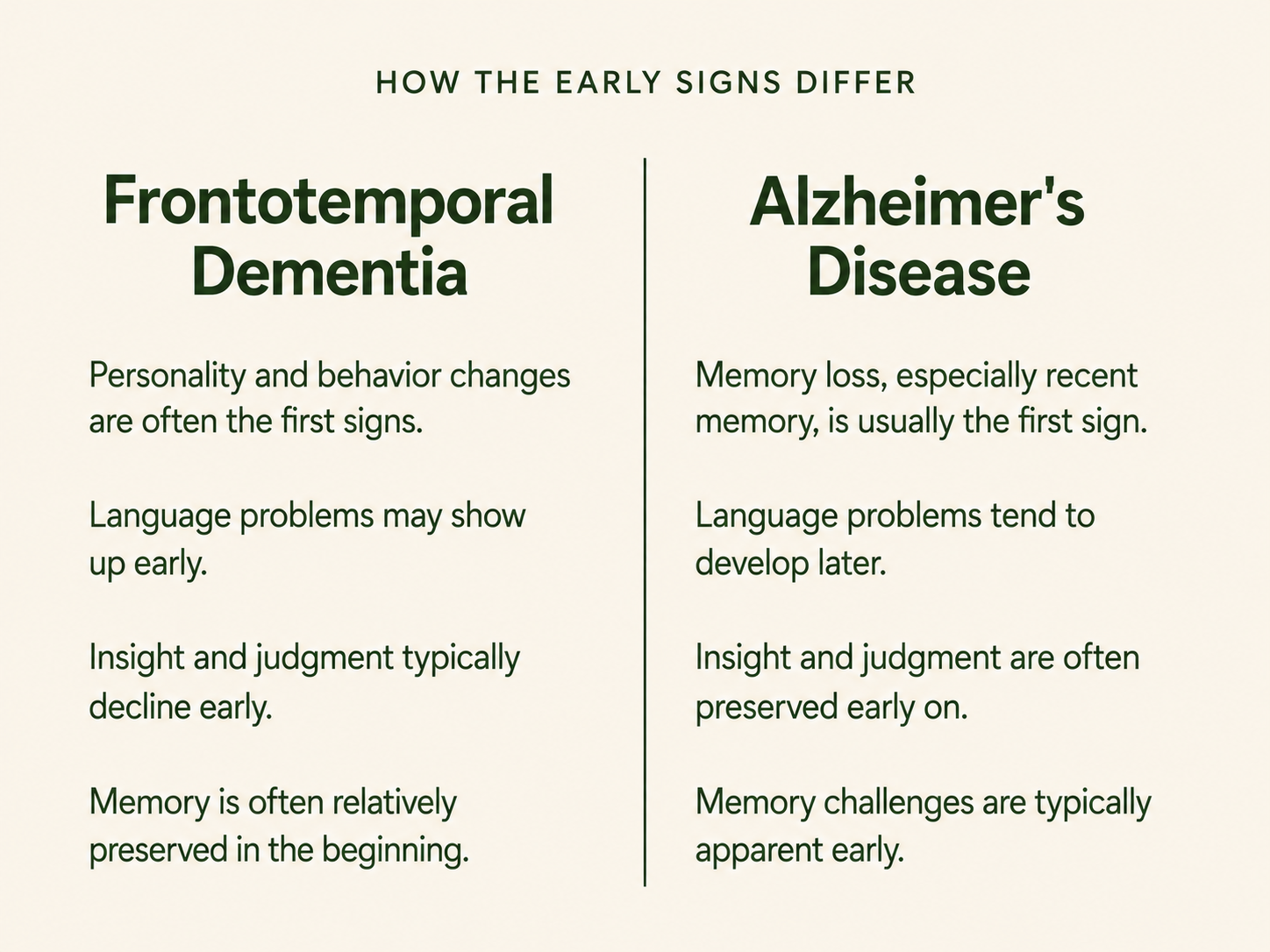
Frontotemporal dementia and Alzheimer's disease often present in opposite order — which is part of why FTD is so frequently misdiagnosed.
The differences between FTD and Alzheimer's are significant enough that families and even some clinicians initially misread one for the other, or miss the diagnosis entirely.
Personality and behavior change first
In behavioral variant FTD, the earliest and most noticeable changes are often personality and conduct, not memory. A person may become impulsive, socially inappropriate, apathetic, or emotionally blunted. They may lose interest in things they once cared about, make uncharacteristic financial decisions, or behave in ways that seem rude or disinhibited to people who don't understand what's happening. Family members frequently describe this as the person becoming "a different person" — which is, in a real neurological sense, exactly what is happening.
Memory is often preserved, at least initially
This is one of the most counterintuitive and painful aspects of FTD for families. A person can be in the grip of significant cognitive change and still remember recent conversations, recognize family members, and navigate familiar routines. This often delays diagnosis, because the symptoms don't match what people expect dementia to look like. Family members are sometimes told by well-meaning friends, or even initially by clinicians, that the person's behavior must be psychiatric, marital, or related to stress — not dementia.
Language can be specifically affected
In the primary progressive aphasia forms of FTD, language is the primary casualty. A person may struggle to find words, lose the ability to understand language, or develop unusual, effortful speech patterns — while their behavior, judgment, and memory remain largely intact for some time. This form is sometimes mistaken for stroke effects or simple word-finding difficulty associated with normal aging.
Insight is frequently impaired
People with behavioral variant FTD often lack awareness that anything is wrong — not as denial, but as a direct effect of the brain damage itself. This makes FTD especially hard on families, because the person experiencing the most significant changes is often the least able to recognize or discuss them. Decisions about safety, finances, and care frequently fall entirely on the family without the collaborative conversation that's often possible earlier in Alzheimer's disease.
"A person can be in the grip of significant cognitive change and still remember recent conversations, recognize family members, and navigate familiar routines."
Why frontotemporal dementia is so often misdiagnosed
On average, it currently takes 3.6 years to get an accurate FTD diagnosis — longer than for Alzheimer's disease. Several factors explain this.
The age of onset works against early recognition. A 52-year-old who becomes withdrawn, makes poor decisions at work, or seems emotionally different is far more likely to be referred for psychiatric evaluation than for dementia workup. Diagnoses of depression, bipolar disorder, midlife crisis, or even relationship conflict are common initial explanations.
The symptom pattern itself works against early recognition. Standard cognitive screening tools used in primary care are heavily weighted toward memory, which means a person with FTD can score normally on a basic cognitive screen while experiencing significant and progressive impairment in judgment, behavior, or language.
And the disinhibition and poor insight that are core features of behavioral variant FTD mean the person experiencing symptoms often cannot accurately report what's happening to them — leaving clinicians dependent on family observation, which is sometimes dismissed or under-weighted in a brief office visit.
A neurologist or neuropsychologist with specific experience in FTD, and a thorough cognitive and behavioral evaluation, are often necessary to reach an accurate diagnosis. Families who suspect FTD and are not getting answers should not hesitate to seek a referral to a specialist with specific dementia or behavioral neurology expertise.
What care for frontotemporal dementia actually looks like
FTD requires an approach to care that looks different from typical dementia support in several important ways.
Structuring the environment around behavior, not memory
Because memory is often preserved, the goal of care isn't the kind of memory cuing common in Alzheimer's support. Instead, care focuses on managing behavior — creating structure and routine that reduces impulsive or inappropriate actions, managing environments to reduce triggers, and using consistent, calm redirection rather than reasoning or argument, which rarely works when insight is impaired.
Safety planning specific to judgment impairment
Impaired judgment in FTD creates safety risks that differ from the wandering or disorientation risks more common in Alzheimer's. Financial vulnerability, impulsive or risky behavior, and poor social judgment all require proactive planning — sometimes including financial safeguards, supervision around driving, and clear protocols for managing the person's interactions with others, including vulnerable situations like scams or exploitation.
Supporting communication in language-variant FTD
For families dealing with primary progressive aphasia, care includes adapting communication strategies as language ability changes — using visual supports, simplified phrasing, and patience with word-finding difficulty, while working closely with a speech-language pathologist who has experience in progressive language disorders.
Caregiver support that acknowledges a different kind of grief
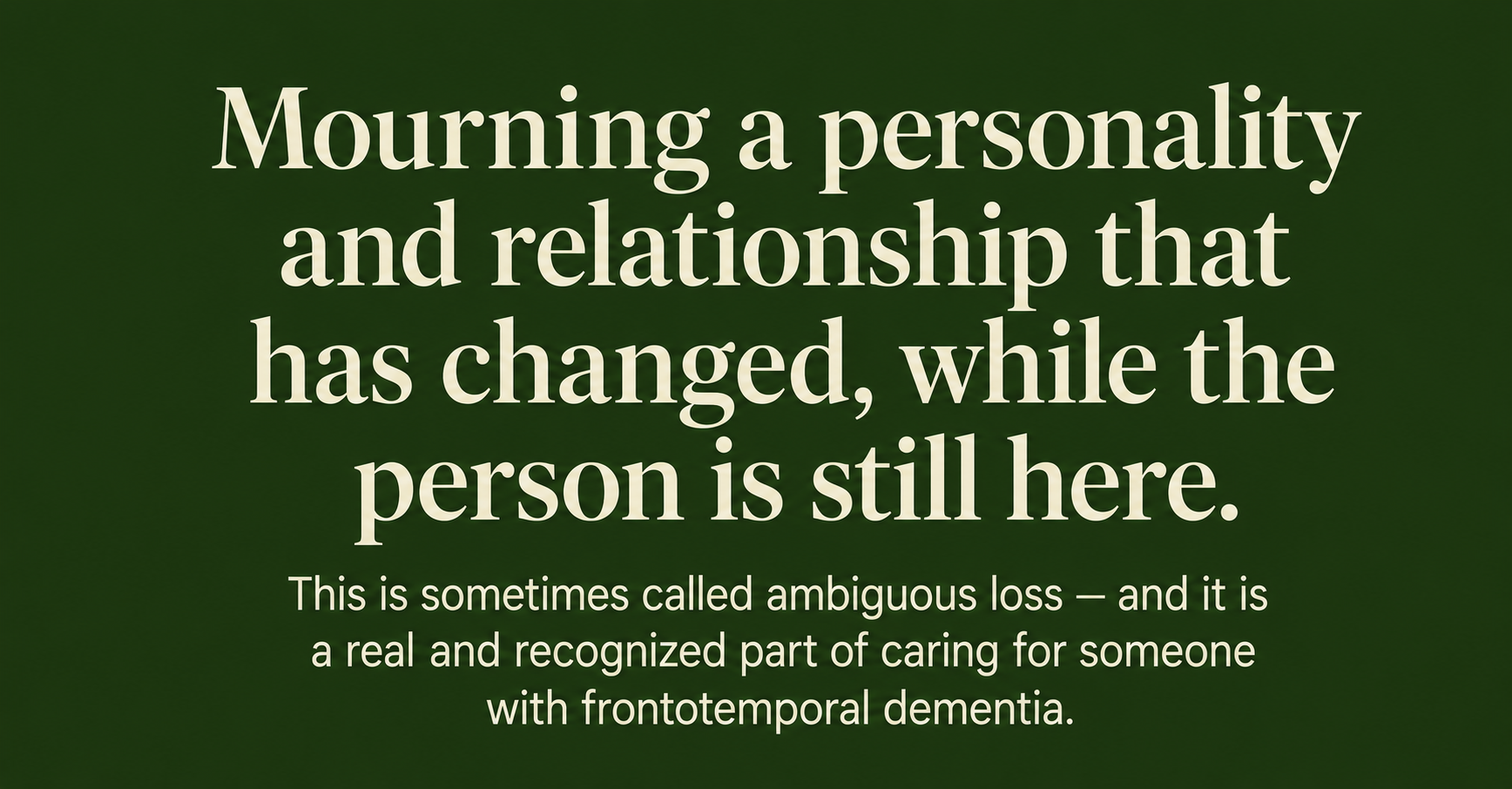
Family caregivers of people with FTD often describe a particular and complicated kind of grief — mourning a personality and relationship that has fundamentally changed while the person is still physically present. This is sometimes called ambiguous loss, and it differs from the grief trajectory more commonly associated with Alzheimer's. Caregivers benefit from support that recognizes this specifically, rather than generic dementia caregiver resources that don't address the behavioral and relational dimensions unique to FTD.
Caregiver training matters as much as caregiving hours
Because the behavioral symptoms of FTD can include disinhibition, impulsivity, or even aggression, caregivers without specific training can find themselves in situations they're unprepared to manage — both for the safety of the person with FTD and for their own wellbeing. Caregivers trained specifically in dementia behavioral management, including frameworks like Teepa Snow's Positive Approach to Care, are better equipped to de-escalate difficult moments and avoid approaches that inadvertently worsen behavioral symptoms.
What families should know about the road ahead
FTD is progressive, and its course varies depending on the specific subtype and the individual. Behavioral and language symptoms often progress over several years, eventually affecting memory, physical function, and in some cases motor control, particularly in subtypes associated with Parkinsonism or ALS.
Because FTD often strikes during working years, families face planning challenges that are less common with later-onset dementias: disability income, dependent children, long-term financial planning compressed into a shorter timeframe, and difficult conversations about a parent's diagnosis with children who may not understand what's happening to someone they depend on.
Genetic counseling is also a meaningful consideration for some families. A meaningful subset of FTD cases — particularly behavioral variant FTD — have a hereditary component. Families with a strong family history of FTD or related conditions may benefit from genetic counseling, both for the affected individual and for other family members who may want to understand their own risk.
Finding the Right Care Support
Frontotemporal dementia asks something different of caregivers than Alzheimer's does. The behavioral complexity, the preserved physical capability paired with impaired judgment, and the unique grief families experience all call for a care team that understands this disease specifically — not dementia care in general terms.
If your family is navigating an FTD diagnosis in the Raleigh or Triangle area, Guiding Light Dementia Care specializes exclusively in dementia care, including the behavioral and communication challenges specific to frontotemporal dementia. Our caregivers are trained in Teepa Snow's Positive Approach to Care, and our RN Director of Care Services provides clinical oversight tailored to each client's specific diagnosis and needs.
Guiding Light Dementia Care provides specialized in-home dementia care in Raleigh, Durham, Chapel Hill, Cary, Wake Forest, and surrounding communities in the Triangle area of North Carolina.
Continue Reading